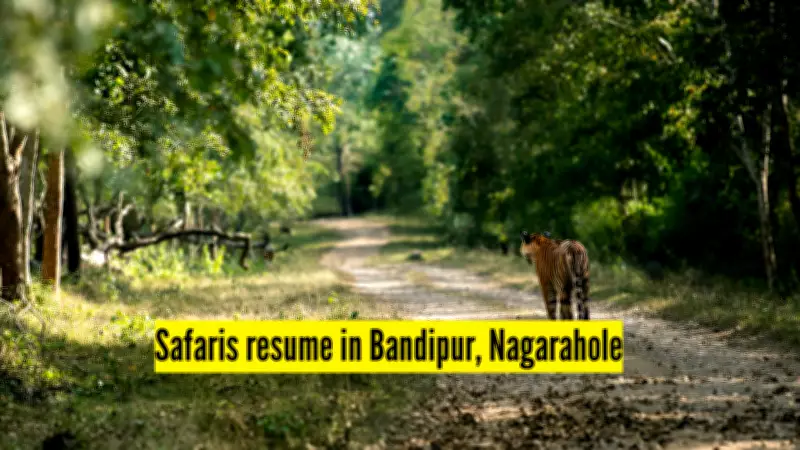
Karnataka Forest Department Reopens Tiger Reserve Safaris with Enhanced Safety Measures
In a significant development for wildlife tourism, safari operations at Bandipur Tiger Reserve and Nagarahole Tiger Reserve have officially resumed as of today. This decision comes following explicit directives issued by Karnataka Forest Minister Eshwar Khandre on Friday, who has implemented a comprehensive set of strict conditions to ensure visitor safety and mitigate human-wildlife conflicts.
Background of the Suspension and New Regulations
The safaris had been suspended since November 7, 2025, after a tragic incident where a farmer lost his life in a tiger attack within Mysuru district. This event raised serious concerns about escalating human-wildlife conflicts in the region, prompting immediate action from forest authorities.
After conducting a thorough review with officials from Mysuru, Kodagu, and Chamarajanagar districts, Minister Khandre announced that operations would restart under tightly controlled circumstances. "Only 50 percent of the safari vehicles and staff that were operational prior to November 7 will be deployed," the minister stated. "Operations should primarily utilize buses, with minimal use of campers and jeeps. Detailed instructions will be formally issued to all concerned parties."

Khandre issued a stern warning that any violation of these stipulated conditions would result in officials being held directly accountable, emphasizing the critical importance of adherence to the new protocols.
Focus on Conflict-Prone Areas and Enhanced Monitoring
The minister has directed forest officials to identify specific human-wildlife conflict-prone areas within both Bandipur and Nagarahole reserves. Patrolling efforts in these zones will be intensified to prevent further incidents. "Precautionary measures must be implemented to ensure wild animals do not enter residential areas, thereby preventing loss of human life and minimizing crop damage," Khandre emphasized.
While certain buffer zones and safari routes in Bandipur remain accessible, their operation will be contingent upon prevailing weather conditions. Bandipur, renowned for its populations of tigers, elephants, leopards, and Indian gaurs, forms an integral part of the Nilgiri Biosphere Reserve.
According to the minister's office, a 100-kilometer stretch along the Bandipur boundary has been classified as highly sensitive. Authorities plan to establish 25 monitoring camps at five-kilometer intervals along this stretch to closely track wildlife movement. Local residents will be appointed as 'forest friends' at each camp, tasked with monitoring animal activity and promptly alerting officials.
Community Engagement and Revenue Sharing Initiatives
Minister Khandre stressed that protecting communities living along forest fringes is equally as important as wildlife conservation. He called for increased attention to crop protection measures for these vulnerable populations.
In a move to foster community participation, the minister announced that thirty-five percent of all safari revenue will be allocated to support fringe villages. These funds will be utilized for skill training programs for local youth, supplying cattle fodder, and supporting children's education initiatives.
"Conservation efforts fundamentally depend on community participation," Khandre noted, directing forest staff to maintain cordial relations with residents while actively involving them in protection initiatives.
Technological Integration and Fire Prevention Measures
The minister has mandated the use of advanced monitoring systems. Permanent forest staff will utilize internally developed e-patrolling software, while outsourced personnel working within tiger reserves must employ the e-stripe system for tracking field activities.
Wildlife movement will be continuously monitored through an integrated command center, enabling prompt instructions to be issued to field staff based on real-time data inputs. Additionally, all complaints received through the dedicated helpline 1926 must be addressed immediately without delay.

With summer months approaching, Khandre has directed officials to implement preventive measures against forest fires in Bandipur, Nagarahole, and Biligiri Ranganatha Hills. "Steps must be taken to ensure tigers, leopards, elephants, and other wildlife do not stray out of forest areas due to shortages of food and water," he instructed.
Safari operations will now proceed under these revised guidelines, which aim to balance tourism activities with significantly strengthened safeguards designed to reduce human-wildlife conflict and ensure sustainable coexistence.