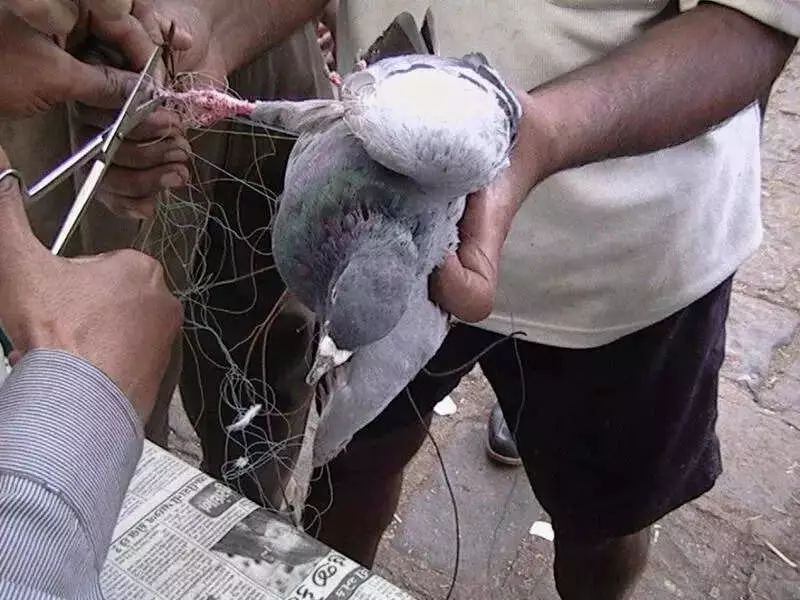
Every year, as the skies of Bengaluru fill with colourful kites during the Sankranti season, a silent wildlife emergency unfolds on the ground. Hundreds of birds suffer severe injuries from 'manja'—the banned, glass-and nylon-coated kite string—turning a festive tradition into a recurring ecological crisis.
A Soaring Number of Avian Casualties
Rescue data from the city's PfA (People for Animals) Wildlife Hospital paints a grim picture of a problem that peaks between January and April. The statistics reveal a shocking escalation: manja-related rescues skyrocketed from 102 cases in 2019 to 790 in 2025. "In 2025, January recorded 85 cases, February 87, March 76, and April 77—accounting for nearly 40% of the year's total rescues," stated Col Dr Navaz Shariff, General Manager and Chief Wildlife Veterinarian at PfA Wildlife Hospital. He added that emergency calls surge daily during these months as birds and bats collide with the nearly invisible strings crisscrossing rooftops, roads, and open spaces.
Black Kites Bear the Brutal Impact
Species-wise data indicates that urban raptors, particularly black kites, are the worst affected. In 2025 alone, 422 black kites were injured, followed by house crows (147), pigeons (44), barn owls (38), and jungle crows (32). The rescue list also included egrets, herons, parakeets, owlets, and fruit bats. "Many of these birds get entangled while flying at dusk or night, when nylon or glass-coated strings are the hardest to detect," explained Dr. Shariff. Over the years, PfA has treated more than 11,000 injured black kites, cementing their status as the most vulnerable species in the city. Conservationists note that the kite-flying season tragically coincides with the fledging period, leaving young and inexperienced birds especially susceptible to horrific manja injuries.

Despite a state ban, the illegal nylon and glass-coated strings remain widely available during festivals, while Karnataka law permits only plain cotton thread. These banned strings inflict slit wings, deep cuts, fractured bones, and permanent disabilities on birds. The danger is not confined to wildlife; numerous cases of deep neck lacerations have been reported among humans in Bengaluru as well.
Innovative Feather Banks and Speedy Rehabilitation
To combat this crisis, the PfA Wildlife Hospital employs a specialised technique called 'imping'—a feather-implantation procedure that replaces broken or missing feathers with naturally shed ones from the same species. This innovation has dramatically slashed rehabilitation time from months to mere days, sometimes even 24 hours. In recent years, this method has facilitated the release of over 1,000 birds back into the wild.
Supporting this effort is a unique, community-driven Feather Bank. Volunteers collect naturally fallen feathers from parks, rooftops, playgrounds, and school premises, with thousands of feathers added to the bank in the last three years. The organisation also uses specialised interlocking poles to rescue birds stranded 80 to 120 feet above ground. As part of its "Kite vs Kites" campaign, PfA actively educates citizens about the dangers Chinese manja poses to birds, bats, and people.
Annual Rescue Cases in Bengaluru:

- 2019: 102 cases
- 2020: 177 cases
- 2021: 633 cases
- 2022: 409 cases
- 2023: 613 cases
- 2024: 469 cases
- 2025: 790 cases