

Bhopal's Upper Lake Faces Steady Water Level Decline, Sparking Supply Concerns
Water levels in Bhopal's Upper Lake, a critical source of drinking water for approximately 40% of the city's residents, have exhibited a consistent and concerning decline during the current pre-monsoon season. This vital reservoir, also known as Bhojtal, serves an estimated 8 to 10 lakh people, and the ongoing depletion raises significant questions about the sustainability of urban water supply as summer intensifies.
Monitoring Data Reveals Significant Drop in Lake Levels
According to official monitoring by the Bhopal Municipal Corporation (BMC), the Upper Lake's water level has decreased notably over a recent period. Specifically, the lake stood at 1663.15 feet on March 9, but by April 5, it had fallen to 1662.10 feet. This represents a decline of 1.05 feet over just 27 days, translating to an average daily depletion rate of about 0.039 feet.
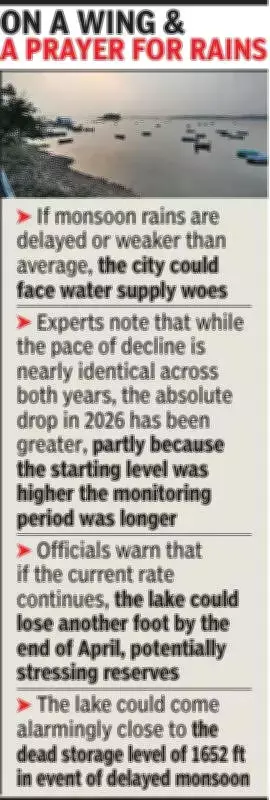
Comparative analysis with last year shows a similar trend, though with some variations. Between March 26 and April 8, 2025, the lake level dropped from 1662.10 feet to 1661.65 feet, a decrease of 0.45 feet over 13 days, averaging 0.035 feet per day. While the pace of decline is nearly identical across both years, the absolute drop in 2026 has been greater, partly due to the longer monitoring period and a higher starting level this year.

Experts Highlight Risks and Seasonal Patterns
Experts and officials have noted that the current depletion rate aligns with typical seasonal patterns, driven primarily by evaporation and reduced inflows during late March and early April. A BMC official commented on the situation, stating, "The depletion rate is consistent with seasonal evaporation and reduced inflows during late March and early April." However, they also emphasized that past summers have witnessed sharper depletion rates, which could bring the lake alarmingly close to the dead storage level of 1652 feet if the monsoon is delayed.
Officials have issued warnings that if the current rate of decline continues, the Upper Lake could lose another foot by the end of April, potentially placing significant stress on water reserves. This scenario underscores the critical importance of the monsoon rains, which historically have been essential for replenishing the reservoir and stabilizing the water supply for Bhopal's population.
Conservation Efforts and Future Outlook
In response to these concerns, the BMC continues to actively urge residents to conserve water and minimize wastage. The approaching summer months highlight the necessity for careful monitoring and robust conservation measures to mitigate risks. If the monsoon rains arrive later than expected or are weaker than average, the city could face substantial challenges in maintaining adequate drinking water reserves.
The situation with Upper Lake serves as a stark reminder of the vulnerabilities in urban water security, particularly in regions dependent on seasonal rainfall. As Bhopal navigates this period, the focus remains on proactive management and community cooperation to ensure sustainable water access for all residents.






