

The Crimson Mystery of Antarctica's Blood Falls Finally Unraveled
When envisioning Antarctica, most picture a vast, pristine landscape dominated by endless white ice and pale blue reflections, where sunlight is scarce throughout the year. However, hidden within this frozen realm lies a startling anomaly: waterfalls flowing with what appears to be blood-red liquid, frozen in dramatic cascades. This gothic spectacle, reminiscent of scenes from zombie or vampire science fiction, is not a product of imagination but a real geological phenomenon that has puzzled observers since its discovery in 1911.
A Red Waterfall in a World of White
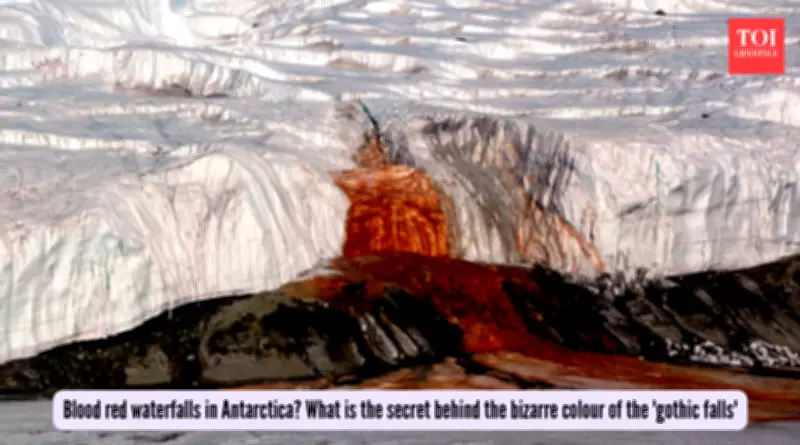
Blood Falls emerges from the Taylor Glacier in Antarctica's McMurdo Dry Valleys, where crimson water spills onto the ice below, creating a stark contrast against the surrounding whiteness. First spotted over a century ago, this rust-colored stream long baffled scientists, with early theories suggesting red algae or sediment deposits as the cause. The truth, as revealed by recent research, is far more intriguing.
The waterfall originates from a hypersaline brine rich in iron, which remains liquid under immense pressure despite subzero temperatures. Upon exposure to air, this brine undergoes rapid oxidation, turning a vivid red hue. A 2023 study led by Ken Livi at Johns Hopkins University, published in Frontiers in Astronomy and Space Sciences, used high-resolution electron microscopy to identify amorphous iron nanospheres within the brine. These non-crystalline particles, previously undetected by conventional X-ray analysis, oxidize instantly when they contact oxygen, transforming clear water into the dramatic red flow observed at Blood Falls.

Life Thriving in Darkness and Cold
Beneath the glacier, an ancient ecosystem of microbes survives in hypersaline, oxygen-poor water, isolated for potentially millions of years. These microorganisms utilize iron and sulfur for energy through chemosynthesis, thriving in conditions devoid of light, warmth, and abundant oxygen. This remarkable adaptation, as noted by Polar Tours, demonstrates life's ability to persist in environments that would be lethal elsewhere, reshaping our understanding of habitability on Earth.
According to National Geographic, this discovery highlights how life can adapt to extreme niches, offering insights into the resilience of biological systems.
Significance Beyond Antarctica: A Mars Analog
Blood Falls serves as a crucial analog for extraterrestrial environments, particularly Mars and Jupiter's moon Europa. The salty, cold, and isolated brines under the ice mirror conditions thought to exist in Martian subsurface reservoirs or Europa's oceans. NASA teams study this site to explore the potential for similar microbial life on other celestial bodies, providing a real-world testing ground for space exploration missions.
This research not only cracks a century-old mystery but also advances our knowledge of how rocks, brine, and microbes interact in extreme settings.
Implications for Science and Exploration
Advances in imaging technology have unveiled the intricate dynamics beneath the ice, offering a clearer picture of these extreme ecosystems. Blood Falls is more than a bizarre natural spectacle; it stands as solid evidence of tough life forms thriving on Earth and provides valuable hints for the search for extraterrestrial biology. As covered by National Geographic, this phenomenon underscores the importance of studying Earth's extremes to unlock secrets beyond our planet.
In summary, the mystery of Antarctica's Blood Falls has been solved through cutting-edge science, revealing iron nanospheres as the culprits behind its crimson color and highlighting the resilience of life in the most inhospitable corners of our world.






