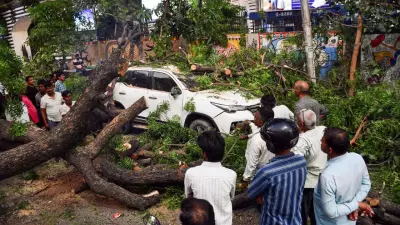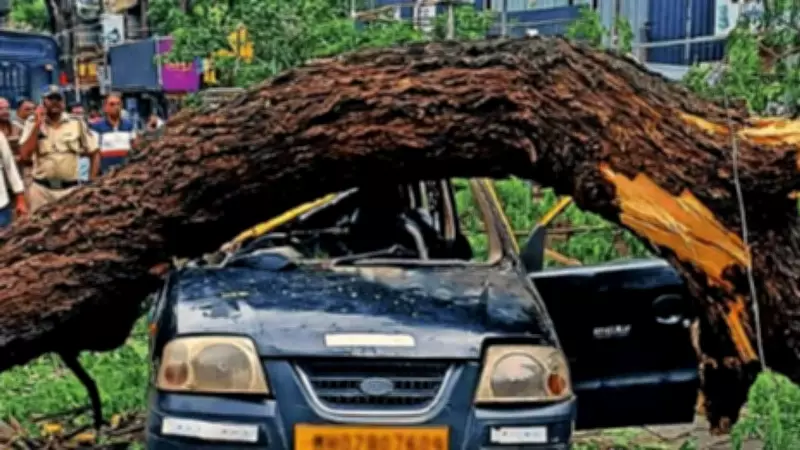
MUMBAI: A day after two young girls were critically injured in a tree crash incident in Khar on May 10, a letter from the BMC's H-West ward office to the Khar police has put an uncomfortable question back on the table—what is killing Mumbai's trees? The letter, accessed by this newspaper, claims the fallen tree was destabilised due to debris dumped around its base. "The tree has fallen due to debris dumped on trees and hence the tree dangerously leaned on the roadside and eventually fell on the autorickshaw," it stated. On the other hand, the developer from whose site the tree fell denied there was destabilisation due to debris and instead said preliminary observations by the company's internal investigative team indicated the possibility of concealed internal decay in the tree, including termite-related weakening, with no visible external signs of structural vulnerability.
While both sides stick to their argument, one thing that is clear is that tree crashes are routinely killing people in the city. Data collated by TOI shows that between May 2023 and May 2026, as many as 125 people have been injured in tree crash incidents across the city while 12 have lost their lives. The civic document on the Khar incident suggests a localised lapse but, based on the number of injured as well as fatalities, residents and experts say the problem is far more systemic—and unfolding across the city in plain sight.
Residents Raise Concerns Over Construction Waste
In Dadar Parsi Colony, for instance, a resident, Burgis Balsara, has been repeatedly following up with the BMC after spotting what he calls "routine burial of trees under construction waste." At VJTI Lane near Five Gardens, amid ongoing road and footpath concretisation, Balsara alleges that contractors have filled multiple tree basins with cement and debris. "Instead of clearing waste after road work, they dumped fresh debris back into the tree basins," he said. "During curing, runoff water seeps into these filled basins. It hardens around the roots. It is slow suffocation." He argues that what appears to be a beautification drive on the surface is quietly damaging what lies beneath.

When TOI spoke to the road department officials from FNorth ward, they said that whenever such instances are flagged, penalty is levied and stringent action is taken. "Even in this case a Rs 25,000 penalty is being levied. This filling of tree basins was not intentional and immediate instructions for clearing of the cement and debris have been given. The roots haven't been impacted in any way," said the official.
Concretisation Project and Arborist Warnings
The BMC's road concretisation project that was started in January 2023 and inaugurated by PM Narendra Modi envisaged the cement-concretisation of 2,164 roads stretching 709.59 km. Out of these, the BMC has completed 1,427 roads with a total length of 400 km while 431 roads (150 km) have been partially completed. Arborists warn that Mumbai's aggressive concretisation push, even if meant to make the roads pothole-free, is failing to account for root systems that extend below footpaths and roads.
"Urban trees are being treated like surface objects, not living systems," said Vaibhav Raje, an arborist who is familiar with civic planting practices. "You cannot cement for a large portion around a tree and expect it to survive heat stress, compaction, and blocked oxygen flow." The concern, he says, is not just tree falls but long-term weakening that makes them vulnerable during heavy rain, wind or heat spikes.
Local Residents and Officials Respond
In Pali Hill, members of local area management groups say the problem is no longer restricted to arterial roads. "Even narrow lanes at Pali Hill area with dense tree cover are being concretised," said Madhu Poplai of the Pali Hill residents association. "Excavation and cement filling around tree bases is becoming routine. It is altering the natural soil structure permanently." Poplai says the worry is not just aesthetics but the gradual loss of mature tree cover in one of Mumbai's greener pockets. As far as trimming of trees goes, Poplai said that they ensure it's done on a periodic basis and not necessarily before monsoons only. "This ensures that all trees don't need trimming and attention only before the onset of the rains," said Poplai.

Hetal Gala, market and garden committee chairperson in the BMC and a corporator from Santacruz, said, "I have demanded that the civic authorities immediately take steps to cut overgrown tree branches and check for dangerous trees on public roads so that we can avert any instances of tree related injuries or fatalities."
BMC Cites Heat Stress as Factor
The BMC, however, maintains that rising temperatures are also a significant factor behind tree instability across the city. Following the Khar tree crash on May 10, a message sent out by the civic garden department internally to all other civic departments pointed out towards the "effect of high temperature stress on trees" especially in the wake of near-40-degree day temperatures that some pockets of Mumbai are reeling under. "The intense heat dries out the soil, causing tree roots to shrink. This reduces their ability to hold firmly onto the ground, making the entire tree unstable and prone to uprooting. The heat causes branches to dry out. These dry branches become brittle and are much more likely to snap and fall, even without a strong wind," read the message. The civic body has begun targeted watering of vulnerable trees and is encouraging citizen participation in maintaining roadside greenery.