

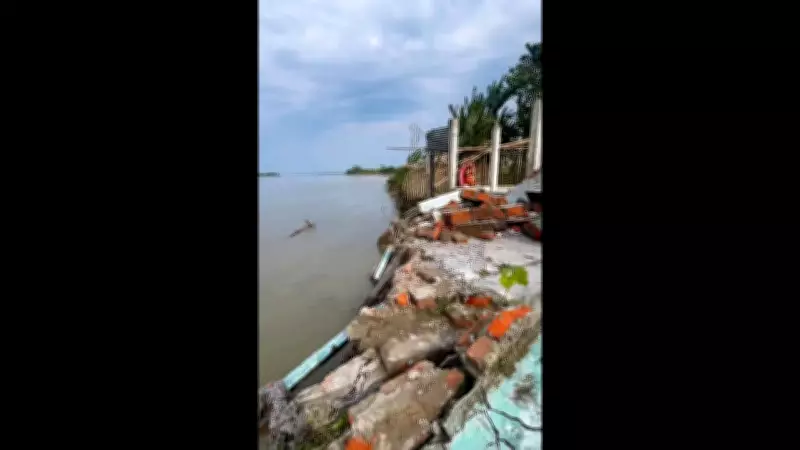
Brahmaputra River's Relentless Erosion Ravages Dibrugarh Village
In a devastating environmental crisis, the mighty Brahmaputra River has unleashed massive erosion over the past week, completely wiping out at least five residential houses and a temple in Dibrugarh's Tengabari Mirigaon area. The powerful river currents have left numerous other structures perilously close to collapse along the vulnerable riverbank, creating an atmosphere of panic and uncertainty among local residents.
Historic Area Including Union Minister's Birthplace Under Threat
The erosion has particularly impacted the Bindhakota region, which holds significant historical importance as the birthplace of Union Minister and former Assam Chief Minister Sarbananda Sonowal. For the villagers of Tengabari Mirigaon, this represents yet another chapter in what has become a recurring nightmare of displacement and destruction that has already claimed agricultural fields and forced families from their homes over previous years.
Residents Voice Desperate Concerns About Impending Monsoon
"We are living in a state of constant fear," expressed Joyraj Mili, a local resident whose community faces existential threats. "The water is rising unexpectedly. If this is the situation in April, we don't know if our village will even exist or not when the peak monsoon arrives in June."

The timing of this severe erosion has particularly alarmed environmental experts and residents alike, as such extensive damage typically occurs during monsoon months rather than in April when river levels are traditionally lower. This early devastation has heightened anxieties about what the actual monsoon season might bring to the already vulnerable region.
Government Anti-Erosion Measures Prove Inadequate
Over recent years, the water resources department has implemented various anti-erosion initiatives designed to protect the Bindhakota belt from the Brahmaputra's destructive forces. These measures have included the installation of thousands of geo-bags and Reinforced Cement Concrete (RCC) porcupine screens along strategic riverbank positions intended to deflect currents and prevent further land sliding.
However, these interventions have largely failed to withstand the river's immense power, with local residents reporting that the protective structures are being washed away with alarming ease.
Villagers Demand Permanent Solutions
"The geo-bags are being washed away like toys," reported Bisarju Pegu, another villager whose home now stands less than ten meters from the eroding river edge. "The government's measures are temporary fixes for a permanent disaster. We need permanent, scientific solutions — not temporary fixes. The government must treat this as an emergency or the entire gaon panchayat will be wiped off the map."
Families Begin Desperate Salvage Operations
As the erosion continues unabated, families whose homes teeter on the brink of collapse have begun undertaking heartbreaking salvage operations. Residents are manually dismantling their dwellings to recover whatever materials and belongings they can save, including tin sheets, timber, and personal possessions, before relocating to higher ground.
This desperate migration represents both a practical response to immediate danger and a symbolic acknowledgment that their ancestral lands may be lost forever to the relentless advance of the Brahmaputra's waters.






