

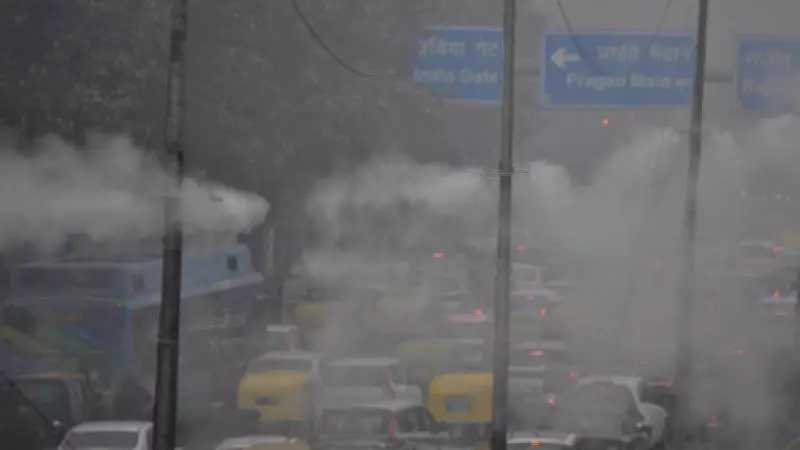
Union Budget 2026 Fails to Prioritize Clean Air for Delhi, Experts Decry Environmental Neglect
In a stark critique of the Union Budget 2026-27, environmental experts have highlighted its failure to address Delhi's chronic air pollution crisis, describing it as a reflection of a mindset that treats the environment as a secondary concern rather than essential survival infrastructure. The criticism emerged during a panel discussion organized by the Impact and Policy Research Institute (IMPRI), a think tank based in Saket, New Delhi.
Explicit Omissions and Misplaced Priorities
Environmentalist Ashish Kothari pointed out that air pollution or environmental issues did not receive any explicit mention in Finance Minister Nirmala Sitharaman's Budget speech. Instead, he noted that substantial financial resources are being directed towards coal, nuclear power, and carbon capture technologies. "The Budget reflects a mindset where the environment is treated as a secondary concern, rather than 'survival infrastructure'," Kothari emphasized, warning that sustainability is impossible if energy demand, especially from luxury and wasteful consumption, continues to rise unchecked.
Increased Coal Funding and Criticisms of Carbon Capture
Soumya Dutta, co-convener of the South Asian People’s Action on Climate Crisis (SAPACC), revealed that allocations for the Coal Ministry have sharply increased this year, reversing a declining trend observed over recent years. He also criticized the continued emphasis on carbon capture, utilisation, and storage (CCUS), labeling it as "a clear anti-climate action, anti-people and anti-clean air action." Dutta argued that CCUS merely addresses carbon dioxide while allowing the indefinite use of coal and oil, which are major sources of toxic co-pollutants. He cited alarming statistics, noting that studies link air pollution to approximately 2.1 million premature deaths annually in India, with economic losses estimated at 8 to 10 percent of the country's GDP.

Inadequate Allocations and Growing Policy Gaps
Economist Professor Krishna Raj from the Institute for Social and Economic Change (ISEC) expressed concern over the widening gap between economic and environmental policies, despite Budget rhetoric about aligning them with sustainable development goals. He flagged inadequate funding for the Ministry of Environment, Forest and Climate Change (MoEFCC), highlighting that only Rs 123 crore has been earmarked for the Central Pollution Control Board (CPCB). "Most of the ministry's budget goes towards salaries and routine expenditure rather than conservation and pollution control," Prof Raj added, underscoring the lack of substantive investment in critical environmental safeguards.
Modest Support for Air Pollution Control and Industrial Growth Disconnect
Prarthana Borah from the Council on Energy, Environment and Water (CEEW) pointed out that while industrial growth is aggressively supported in the Budget, parallel investments to ensure cleaner production are missing. She referenced emissions inventories indicating that 21-35 percent of India's air pollution stems from industrial sources, yet direct budgetary support for air pollution control remains modest. Borah noted that allocations have increased only slightly, from about Rs 850 crore to Rs 1,091 crore, with minimal increases for the Commission for Air Quality Management and the CPCB. "So in terms of direct interventions, it's going to be disappointing," she stated.
Cuts in Urban Environmental Programs and Resilience Concerns
Borah also highlighted significant reductions in urban environmental initiatives, including a 50 percent cut in the Swachh Bharat Mission (Urban) and sharp decreases in public transport schemes like the PM E-Bus Sewa. "These cuts show a complete anomaly between what is actually happening in the country and what we see in the Budget," she argued, warning that instead of strengthening urban climate resilience and pollution control, such measures make cities more vulnerable to environmental hazards.

Conclusion: A Call for Substantive Action
The panel collectively concluded that without a substantial scale-up in allocations to the environment ministry, pollution control agencies, and city-level infrastructure, India's worsening air quality crisis is unlikely to see meaningful improvement. This is despite growing rhetoric around green growth and sustainability in policy discussions. The experts' analysis underscores an urgent need for the Budget to prioritize clean air as a fundamental component of public health and economic stability, rather than relegating it to the sidelines of national planning.





