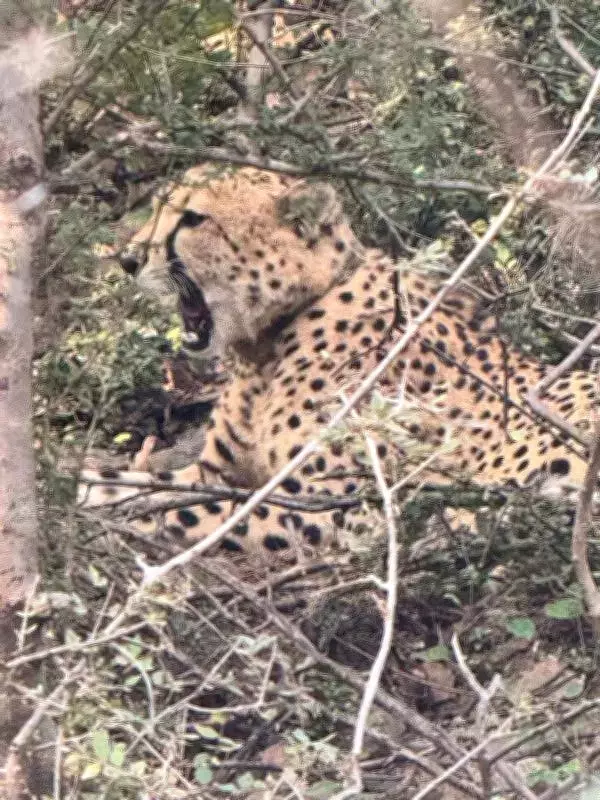
Cheetah KP-2 Crosses into Rajasthan Again, Sparks Inter-State Coordination Debate
In a recurring wildlife event, a cheetah from Kuno National Park (KNP) in Madhya Pradesh has crossed state borders and entered Rajasthan for the second time in recent months. The animal, identified as KP-2, has been lingering in the Ramgarh Crater area of Baran district for the past seven days, drawn by the region's abundant prey base, according to forest officials.
Repeat Journey and Monitoring Efforts
This marks the second such excursion for KP-2, who previously strayed into the same region in December last year and remained there for nearly 17 days before being tranquilised and relocated back to Kuno. Joint teams from the Baran and Kuno forest divisions are now closely tracking the movements of this India-born cub. An advisory has been issued to local villagers, urging them not to approach the animal and to remain calm.
Field officials monitoring the situation report that KP-2 appears to have adapted well to the local landscape and prey availability. Wildlife enthusiast Banwari Kumar noted that the cheetah followed the same route into Rajasthan as during its earlier journey, suggesting a familiar pattern of movement.

Experts Caution Against Repeated Tranquilisation
Experts have advised against tranquilising and relocating the cheetah again, citing health concerns. "The animal was put under barely two months ago, and repeated tranquilisation could have adverse effects on its well-being," they warned. Kumar echoed this sentiment, stating, "Forest teams should allow the animal to move on its own and avoid tranquilising it unless absolutely necessary."
Lack of Formal Inter-State Framework
The incident has highlighted a significant gap in inter-state coordination. Officials indicated that the absence of a formal framework for managing such cross-border movements has complicated the response. A proposed Memorandum of Understanding (MoU) between Rajasthan and Madhya Pradesh, aimed at conducting a feasibility study on the free movement of cheetahs between KNP and the broader Kuno-Gandhi Sagar cheetah landscape, remains unsigned.
"We obtained approval for the MoU from our government. Madhya Pradesh also secured approval and shared the draft with us. Had it been signed, studies could have commenced, the Wildlife Institute of India could have been involved, and groundwork for developing cheetah grasslands and a coordinated strategy could have begun," a senior official explained.
The Rajasthan Forest Department presented the proposed MoU before the state board in a meeting on June 23, but formal approval is still pending.
Broader Cheetah Landscape and Objectives
The larger Kuno-Gandhi Sagar cheetah landscape spans approximately 17,000 square kilometers, including 10,500 square kilometers in Madhya Pradesh and 6,500 square kilometers in Rajasthan. It covers several districts in both states, with adjacent districts in Uttar Pradesh also considered part of the broader landscape based on previous movement patterns.
Earlier incidents include a female cheetah, Jwala, straying into a village in Sawai Madhopur district before being tranquilised and returned to Kuno, and another cheetah crossing into Karauli district last year.
The draft MoU outlines broader objectives, such as using the cheetah as a flagship species for restoring open forests and savanna ecosystems, enhancing biodiversity, and strengthening ecological balance. It proposes that both states permit the capture, recapture, or release of cheetahs in emergency situations, in accordance with the Wildlife (Protection) Act, 1972, and protocols established by the Union Ministry of Environment, Forest and Climate Change and the National Tiger Conservation Authority.