

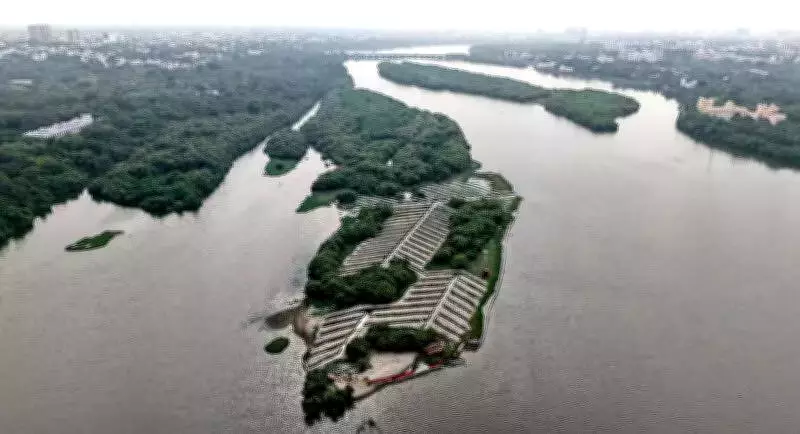
Chennai Expands Coastal Bio-Shield with Major Mangrove Plantation Drive
In a significant environmental initiative, forest officials in Chennai have successfully planted 20,000 mangrove saplings along the Buckingham Canal near Kazhippattur village on Old Mahabalipuram Road. This marks the third phase of a comprehensive coastal restoration project aimed at bolstering the city's natural defenses against climate change and coastal erosion.
Phased Approach to Large-Scale Restoration
The mangrove restoration drive has been implemented in phases over the past two years, demonstrating a sustained commitment to ecological enhancement. In the initial phase, approximately 12,500 saplings were planted along the banks of the Buckingham Canal near Kazhippattur. The second phase involved the planting of 5,000 saplings on the Battle of Adyar Island, also known as Quibble Island, along the Adyar River between the Theosophical Society campus and MRC Nagar.
According to Forest Officer V A Saravanan, the latest plantation was strategically carried out adjacent to the earlier site along the canal to expand the restored mangrove habitat. This expansion is crucial for creating a contiguous natural barrier that can effectively protect the coastal region.

Engineering the Environment for Mangrove Growth
Prior to the plantation exercise, the forest department undertook meticulous groundwork to ensure the success of the mangrove saplings. They created a sophisticated network of eight fishbone-shaped canals, supported by 186 distribution canals. These channels are ingeniously designed to allow saline water to enter during high tide and drain out during low tide, thereby creating optimal conditions for mangrove growth and survival.
Environment Secretary Supriya Sahu emphasized that the project is a core component of efforts to establish a natural coastal bio-shield for Chennai. The initiative is focused on enhancing climate resilience through large-scale mangrove restoration, which serves as a vital buffer against environmental threats.
Diverse Species and Ecological Benefits
The third phase of the plantation involved a diverse mix of mangrove species, including 9,696 Avicennia marina saplings, 1,495 Avicennia officinalis, 3,602 Rhizophora mucronata, 726 Rhizophora apiculata, and 4,481 Excoecaria agallocha. This biodiversity is essential for creating a robust and resilient ecosystem.
Officials highlighted the multifaceted benefits of mangroves, noting that they play a critical role in preventing coastal erosion, acting as natural buffers against floods and storm surges, supporting rich biodiversity, and improving the overall ecological health of waterways. These functions are increasingly important in the face of rising sea levels and extreme weather events.
Nurturing and Transplanting the Saplings
The saplings used in this initiative were carefully grown at department nurseries located at Nanmangalam forest and at the Maritime University on OMR. It took approximately nine months for the saplings to reach a suitable size for transplantation, underscoring the long-term planning and dedication involved in the restoration project.
This extensive mangrove plantation not only contributes to environmental conservation but also aligns with broader goals of sustainable urban development and climate adaptation for Chennai.






