

Chennai's Polluted Air Transforms into Artistic Medium at 'Pugai Padam' Exhibition
Framed stencils depicting a red-wattled lapwing, a glowing sunrise, fish, and a butterfly, all rendered in ashy grey tones, dominate the gallery walls. What immediately strikes visitors is the complete absence of any artist's signature on these compelling works. "The true 'artist' behind these creations is the city's heavily polluted air itself," explains Archanaa Seker, one of the key organizers of the groundbreaking 'Pugai Padam: When Smog Makes Art' campaign.
This innovative three-day art initiative opened in Chennai on February 4th, with a powerful mission to confront the city's escalating air pollution crisis head-on. Organized by the Pugai Padam Collective—a coalition of youth groups and art activists—the campaign directly challenges the state's reliance on conventional air quality indices, digital dashboards, and academic studies while pollution levels continue to worsen unchecked.
The 'Smog Plates': Capturing Pollution as Art
At the exhibition's core are the revolutionary 'smog plates,' an artistic medium inspired by Los Angeles-based artist Kim Abeles. These specially prepared flexi glass plates were strategically installed across fourteen different locations throughout Chennai, many identified as notorious pollution hotspots including Thiruvottiyur, Kodungaiyur, Kuruvimedu, Kikatalai, Mylapore, Besant Nagar, Saidapet, and Velachery.

Each plate was left exposed for an entire month, silently absorbing particulate matter and transforming into unique environmental artifacts. "Every plate features a distinct stencil design that reflects its specific location," Archanaa elaborates. "For Chromepet, we used a belt stencil to represent the area's leather tanneries. In Kodungaiyur, a plastic cover stencil symbolizes the massive dump yard. Alongside these pieces, we've displayed photographs and detailed captions describing the homes where this smog was collected, illustrating the daily realities for families living in these polluted environments."
Powerful Installations Highlight Human Impact
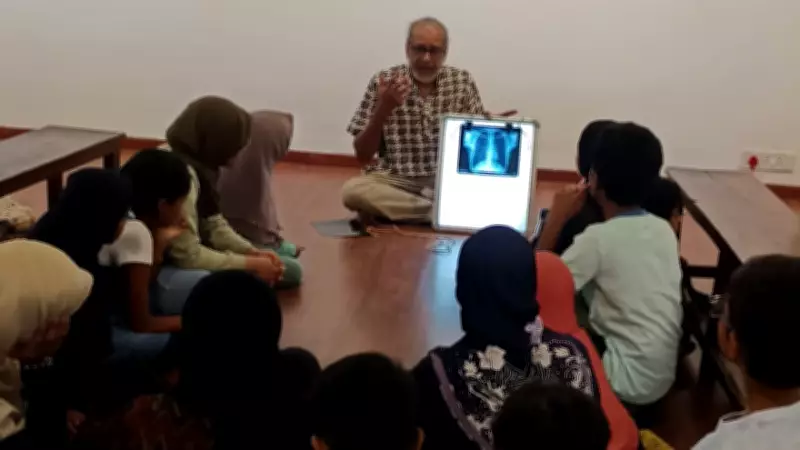
The exhibition extends beyond the smog plates with a series of impactful installations. One striking display features chest X-rays comparing healthy lungs with those damaged by prolonged pollution exposure. Another poignant exhibit shows a child's school uniform from Kattukuppam, accompanied by a note explaining how children in the area are routinely asked to bring an extra set of clothes because coughing and vomiting episodes are so frequent.
"We've also created detailed recreations of the interiors of steel workshops scattered around Korukkupettai," adds Archanaa, emphasizing the exhibition's commitment to authenticity and representation.
Resident Testimonies and Theatrical Performance
Subbalakshmi, a resident of North Chennai whose neighborhood features prominently in the exhibition, shares her lived experience: "Living with pollution has become almost routine for us. We know the air is making us sick, but our work, our homes, everything is rooted here. We cannot afford rents in other parts of the city, so we cannot simply leave."
The campaign further amplifies these voices through 'Maasu Kadhaigal,' a powerful play scheduled for performance on Sunday between 5 PM and 6 PM. Co-scripted and enacted by youth from the Arunodaya Centre in North Chennai, the performance draws from everyday encounters with toxic air, illness, and loss. It portrays stories of a mother packing extra uniforms for a child who coughs until vomiting, a homemaker sweeping mounds of dust three times daily, and a young man living beside a coal-ash pond with toxic dust permanently caked in his nose and ears.
The 'Pugai Padam' exhibition remains open to all visitors from 3 PM to 7 PM until February 8th, offering a rare opportunity to witness environmental crisis transformed into compelling artistic testimony.






