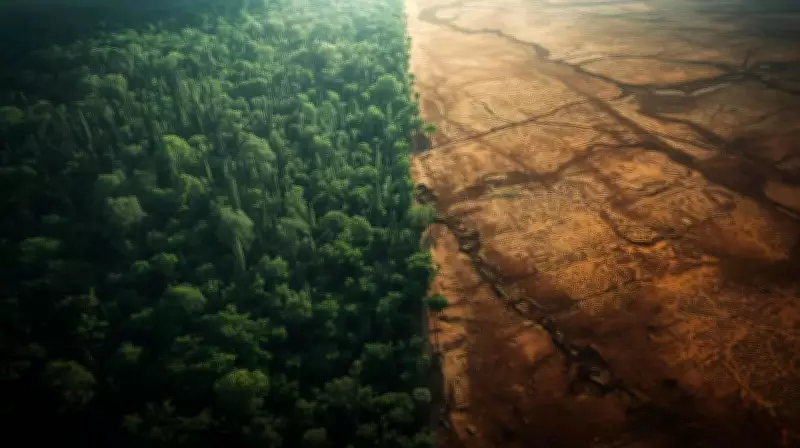
Human Ingenuity Rewrites Nature's Rules in Earth's Harshest Desert
Human beings possess an extraordinary capacity to achieve what seems nearly impossible, including breathing life into landscapes where existence appears unimaginable. In the vast, arid expanse of the Taklamakan Desert, one of Earth's driest and most hostile environments, human determination has quietly rewritten the fundamental rules of nature through a monumental ecological intervention.
From Biological Void to Green Barrier
The Taklamakan Desert spans approximately 130,000 square miles in northwest China, comparable in size to the state of Montana. Encircled by mountains that trap moisture year-round, this region was historically labeled a "biological void" with over 95% shifting sands. Following urbanization and agricultural expansion in the 1950s, the desert began expanding, leading to increased sandstorms and further desertification of surrounding lands.
In 1978, China launched an ambitious environmental project known as the Three-North Shelterbelt Program, often called the "Great Green Wall." This initiative aimed to plant billions of trees by 2050 around both the Taklamakan and Gobi deserts to halt desert creep. By late 2024, this effort had successfully created a remarkable 3,000-kilometer vegetation belt encircling the Taklamakan Desert, contributing significantly to China's overall forest cover increase from 10% in 1949 to over 25% today.

The Surprising Transformation into a Carbon Sink
A groundbreaking study published in PNAS reveals that this extensive greening has transformed the desert's edges into a functioning carbon sink, absorbing more atmospheric carbon dioxide than it releases. Researchers analyzed 25 years of comprehensive satellite data tracking rainfall patterns, plant coverage, photosynthesis rates, and CO2 flows, supplemented by ground verification and NOAA's Carbon Tracker models.
The data shows that during wet-season months from July through September, when rainfall averages 16 mm monthly (2.5 times higher than drier months), the supercharged vegetation along the desert rim reduces atmospheric CO2 from 416 parts per million during dry periods to 413 ppm during wet periods.
"We found, for the first time, that human-led intervention can effectively enhance carbon sequestration in even the most extreme arid landscapes, demonstrating the potential to transform a desert into a carbon sink and halt desertification," explained study co-author Yuk Yung, a planetary science professor at Caltech and researcher at NASA's Jet Propulsion Laboratory.
How Plants Performed Their Environmental Magic
Previous research suggested that desert sands might temporarily trap some carbon dioxide, but warming temperatures could potentially release this stored carbon, unlike the more stable carbon sequestration provided by living vegetation. The vegetation growth along the Taklamakan's rim correlates precisely with the implementation of the Great Green Wall project, with heavy machinery and hardy shrubs stabilized by mountain runoff transforming previously shifting dunes.
While the broader planting of over 66 billion trees across northern China has shown mixed results in reducing sandstorms, the success along the Taklamakan's edges represents a significant environmental breakthrough. "Based on the results of this study, the Taklamakan Desert, although only around its rim, represents the first successful model demonstrating the possibility of transforming a desert into a carbon sink," Yung emphasized, noting that this achievement provides a valuable blueprint for other arid regions worldwide despite ongoing water availability challenges.
This remarkable transformation demonstrates how strategic human intervention can convert even Earth's most inhospitable landscapes into contributors to global climate solutions, offering hope for similar initiatives in other desert regions facing environmental degradation.