Christianity's Global Transformation: From European Stronghold to African Heartland
For nearly two thousand years, Christianity expanded from its origins as a small Jewish sect in the eastern Roman Empire to become the world's largest religion. This remarkable journey saw imperial endorsement in the 4th century, medieval missionary networks across Europe, and colonial-era evangelization in the Americas, Africa, and parts of Asia steadily widening its global reach.
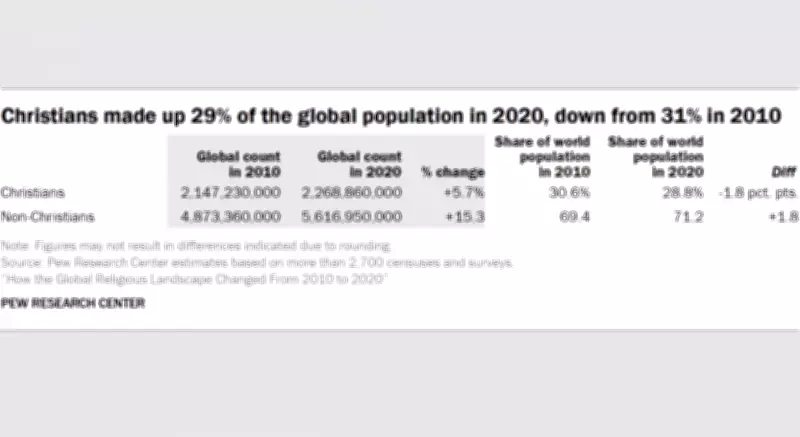
By 2020, Christianity still accounted for the biggest share of humanity at 28.8% of the global population, representing approximately 2.3 billion people. However, the newest demographic analysis from the Pew-Templeton Global Religious Futures project reveals a quieter transformation beneath that headline dominance. Christianity continues to grow in raw numbers but is shrinking proportionally, losing followers in dozens of countries while expanding rapidly in others, and shifting geographically away from its historic European base toward sub-Saharan Africa.
From Imperial Religion to Global Majority
Christianity's early spread relied on itinerant preachers and tightly knit communities offering social support and the promise of universal salvation. Its trajectory changed dramatically after Emperor Constantine legalized the faith in 313 AD, and later when it became the Roman state religion. Medieval missions carried it across Europe, and from the 15th century onward, European expansion exported it worldwide.

Colonial powers including Spain, Portugal, Britain, France, and Belgium often paired territorial expansion with conversion efforts. Missionaries established schools and medical services, translated scripture, and in some regions used coercive systems of taxation and law to suppress indigenous religions. By the modern era, Christianity had become a global majority faith across multiple continents.
The Geographic Shift: Africa Rises as Europe Declines
Between 2010 and 2020, Christianity grew by 6%, from 2.1 billion to 2.3 billion adherents, maintaining its position as the world's largest religion. However, the global population grew faster, and non-Christians increased by 15%, causing Christianity's share to fall from 31% to 28.8%. This includes all Christians counted under a single category, encompassing Catholics, Orthodox Christians, and Protestant denominations such as Baptists, Lutherans, Anglicans, Methodists, and Pentecostals.
The decade's most striking change is geographic rather than numerical. Christianity's historic center of gravity, Europe, no longer holds the largest Christian population. The number of Christians fell in two key regions:
- In Europe, Christians declined to 505 million (down 9%)
- In North America, they shrank to 238 million (down 11%)
In every other region, the number of Christians grew, with the most significant increase occurring in sub-Saharan Africa, which reached 697 million Christians (up 31%). By 2020, 31% of all Christians lived in sub-Saharan Africa, compared with just 22% in Europe. Latin America and the Caribbean accounted for 24% of global Christians, while North America represented 10%.
Where Christianity Declined and the One Place It Grew
Substantial change, defined as at least a five-percentage-point shift, occurred in 41 countries, more than for any other religion. In all but one of these countries, Christianity declined. The largest drops included:
- Australia: down 20 percentage points
- Chile: down 18 percentage points
- Uruguay: down 16 percentage points
- United States: down 14 percentage points
- Canada: down 14 percentage points
- Benin: down 5 percentage points
In several countries, Christianity lost majority status:
- United Kingdom: 49%
- Australia: 47%
- France: 46%
- Uruguay: 44%
In each case, religiously unaffiliated people rose to 40% or more of the population. Mozambique was the only country with a substantial increase, rising 5 points to 61%, following the end of an anti-religious government campaign in the 1980s. Overall, Christians remained the majority in 120 countries and territories, down from 124 in 2010.

The Mechanism: Switching Out of Religion
The central driver of change was not birth rates alone but religious switching. Christians experienced the largest net losses: for every one person who joined Christianity, 3.1 left it. Most did not join another religion but became religiously unaffiliated. This movement explains both Christianity's declining share and the simultaneous growth of the "nones" (religiously unaffiliated individuals).
Globally, religious switching shows a clear direction: more people leave religion than adopt one. Among adults aged 18-54, 3.2 people leave religion for every one who joins. While Christians have relatively high birth rates, switching offsets this natural growth. By contrast, Muslim population growth is driven mainly by a young age structure and higher fertility, not conversion.
A Changing Religious Landscape
By 2020, the global religious landscape had evolved significantly:
- Christians: 28.8% (2.3 billion)
- Muslims: 25.6%
- Religiously unaffiliated: 24.2%
- Hindus: 14.9%
- Buddhists: 4.1%
Globally, 75.8% of people identified with a religion, while 24.2% did not. The unaffiliated now make up 24.2% of the global population, driven largely by Christian disaffiliation. The data shows Christianity remaining the world's largest religion but increasingly concentrated in the Global South and increasingly shaped by disaffiliation in the West. Over the past century, it spread across continents; in the past decade, its center quietly moved from Europe to Africa.