

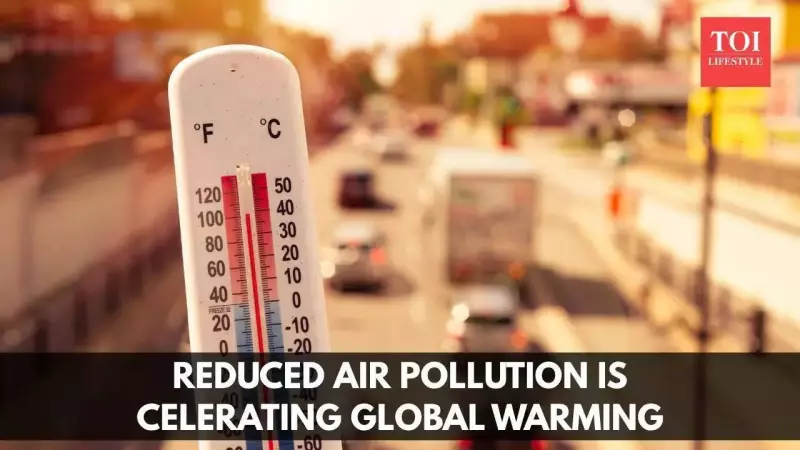
In a startling climate change revelation, a new scientific study confirms our planet is now absorbing significantly more solar heat than it did just two decades ago. Published in the prestigious journal Nature Communications, the research demonstrates how global warming is accelerating at a pace that has surpassed even the most concerned climate scientists' projections.
The Clean Air Paradox: How Reducing Pollution Accelerates Warming
Scientists have uncovered a troubling paradox: while reducing air pollution benefits human health, it inadvertently contributes to faster planetary warming. The research team analyzed twenty years of satellite data, focusing on cloud behavior over the northeastern Pacific and Atlantic Oceans—regions experiencing rapid surface temperature increases.
The study found that clouds above these critical ocean areas became nearly 3% less reflective each decade between 2003 and 2022. Approximately 70% of this dramatic reduction in cloud reflectivity stems from decreasing aerosol levels in the atmosphere.

"This paper represents a substantial contribution to the evidence that reductions in particulate air pollutants are contributing to accelerated warming," stated Sarah Doherty, a principal research scientist at the UW Cooperative Institute for Climate, Ocean and Ecosystem Studies.
Understanding the Science Behind Dimming Clouds
Aerosols—fine particles released through fossil fuel combustion—have long played a complex role in climate dynamics. While harmful to human respiratory health, these particles paradoxically helped cool our planet by making clouds more reflective and deflecting sunlight away from Earth's surface.
The research identifies two primary mechanisms through which aerosols influence cloud behavior:
- Small aerosol particles provide surfaces for water droplets to form, creating numerous small, reflective droplets within clouds
- With fewer aerosols, cloud droplets grow larger, become heavier, and fall as precipitation more quickly, reducing cloud cover and longevity
"When you cut pollution, you're losing reflectivity and warming the system by allowing more solar radiation to reach Earth," explained lead author Knut von Salzen, a senior research scientist of atmospheric and climate science at UW.
Rethinking Climate Strategy in a Warming World
The findings carry profound implications for climate modeling and policy. The masking effect of pollution had been insulating Earth from the full impact of greenhouse gases for decades. As air quality improves worldwide, the unmasked warming emerges more forcefully.
"We may be underestimating warming trends because this connection is stronger than we knew," von Salzen warned. "I think this increases the pressure on everyone to rethink climate mitigation and adaptation, because warming is progressing faster than expected."
Despite the concerning findings, scientists emphasize that reducing air pollution remains critically important. "It is clearly a good thing that we have been reducing particle pollution in the atmosphere. We don't want to go back in time and take away the Clean Air Act," Doherty affirmed.
Researchers are now exploring innovative solutions, including marine cloud brightening—a technique where ships spray seawater into the air to enhance cloud reflectivity without pollution. "You could think of it as replacing unhealthy pollutant particles with another type of particle that is not a pollutant—but that still provides a beneficial cooling effect," explained Robert Wood, a UW professor of atmospheric and climate science.
The record-breaking temperatures of 2023 and 2024, which exceeded climate scientists' projections, now appear directly connected to this newly understood phenomenon of reduced planetary reflectivity. As the world transitions toward cleaner energy, understanding these complex atmospheric interactions becomes increasingly vital for accurate climate forecasting and effective policy responses.






