

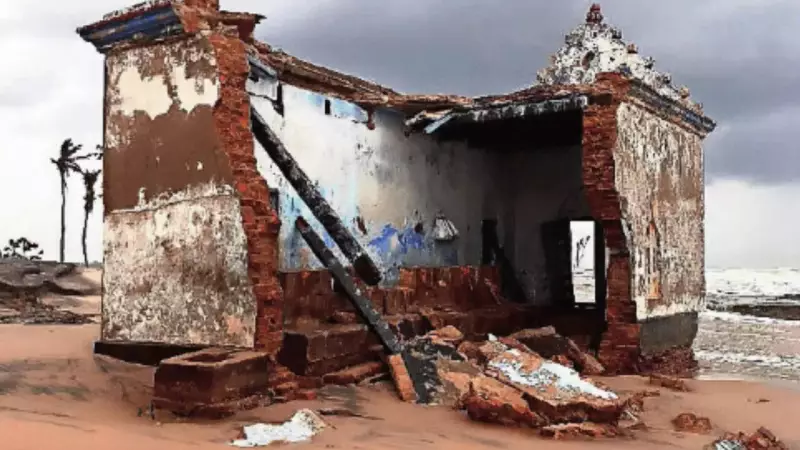
The relentless advance of the sea along India's eastern coast is not just redrawing maps; it is erasing entire communities and their ways of life. For villages in Odisha, government-led relocation offers an escape from the encroaching waves, but it often comes at the devastating cost of lost livelihoods, leaving families stranded in safety.
The High Price of a Safe Haven
For octogenarian Krushna Chandra Behera, the promise of safety in Odisha's Bagapatia resettlement colony is bittersweet. His former home, Satabhaya village in Kendrapara district, was slowly consumed by the sea, prompting a state government decision to move residents as far back as 1992. The chosen site, Bagapatia, lies 12 kilometres inland. "Though some people have fertile land there, who will travel 12km daily to carry on farming after crossing the Bhitarkanika mangrove forest and a crocodile-infested river?" Behera asks, highlighting the impractical distance from their original sources of income.
The relocation process was painfully slow. The foundation stone for the colony was laid only in 2004, with the first batch of 571 families moving in between 2017 and 2018. In April 2018, the deities of the Panchubarahi temple, traditionally served by Dalit women priestesses, were also relocated to a new temple in Bagapatia with great ceremony. The state government touts Bagapatia as India's first resettlement colony specifically for victims of climate change and coastal erosion. Yet, for its inhabitants, the most critical challenge remains unresolved: how to earn a living.

Livelihoods Washed Away
The dilemma is stark. Ashok Pradhan, a neighbour of Behera in Bagapatia, states plainly, "Government gave us land to build houses, not to farm. The sea is too far for fishing. How do we earn?" This sentiment echoes throughout the colony. Debendra Rout, 43, describes a tragic shift from self-sufficiency to dependence. "We were self-sufficient before. Now, we are daily-wagers and migrant labourers," he said. "Except elderly people, children, and women, most of the displaced people of Satabhaya are going to other states in search of jobs. We are staying like refugees here."
The story repeats in other erosion hotspots. In Ganjam district, 463 families from Podampeta village were moved to Podagada and Mayurpada between 2011 and 2016. Ch Shyama, a ward member, lamented, "We lost our houses, fish-drying ground, and livelihood. We left the village with a heavy heart." For those who remain in vanishing villages like Satabhaya, life is a tense waiting game. Jagabandhu Behera, who stays with his family in the now-abandoned village, fears, "I do not know when my hut will be washed away by the sea."
Even for fishermen who have been rehabilitated nearby, the disconnect is fatal. L Bhogiraju of Rameyapatna village in Ganjam, also district president of the Traditional Fish Workers Union, explains, "We need to stay near the beach for fishing activities. That's why many people are staying in this village only."
A Coastline Under Siege
The scale of the crisis is vast. In December last year, Odisha's Environment Minister Ganesh Ram Singkhuntia informed the state assembly that 46 villages across Kendrapara, Puri, and Ganjam districts have been severely affected by coastal erosion. According to a 2022 report by the National Centre for Coastal Research (NCCR), a third of India's 7,000-km mainland coastline faces erosion threats. On the east coast, which is particularly vulnerable, around 1,205 km of its 3,144 km length is under siege.
Odisha has borne a sustained assault. Between 1990 and 2018, over 140 km—about 25%—of Odisha's 549-km coastline experienced erosion. The situation is even more dire in neighbouring West Bengal, where over 60% of the coastline is eroding, with the Digha-Sankarpur stretch and parts of the Sundarbans among the worst-hit.
R S Kankara, Director of NCCR, explains that while coastal erosion is natural, human actions exacerbate it. Rivers supplying sediment are disrupted by dams and changing monsoon patterns, creating a deficit that fuels erosion. Pratap Kumar Mohanty, former head of marine science at Berhampur University, warns the situation in Odisha is likely to worsen, exacerbated by frequent cyclones like Fani since 2018.

Seeking Solutions on Shifting Sands
Experts advocate for targeted, location-specific interventions to mitigate the impact. These include creating and protecting mangrove forests that act as natural buffers, alongside constructing sea walls and saline embankments. However, Balaji Ramakrishnan, Director of the National Institute of Ocean Technology (NIOT), cautions that solutions must be scientifically assessed for each stretch to avoid destabilising another area.
As the sea continues its inward march, the stories from Odisha's resettlement colonies underscore a harsh reality: providing safe shelter is only the first step. Without viable economic alternatives, the security gained from relocation remains hollow, leaving thousands of climate refugees in a precarious limbo between survival and sustenance.
