

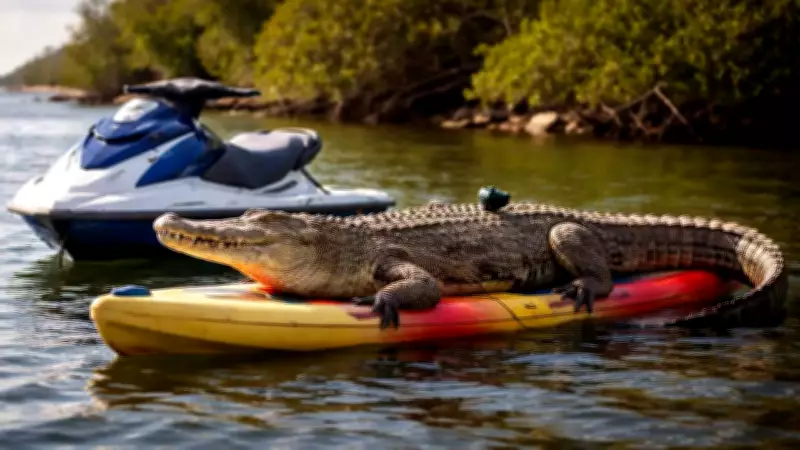
Crocodiles Adapt to Human Encroachment by Sunbathing on Jet Skis and Kayaks
Witnessing a crocodile lounging on a jet ski or a kayak might seem like a scene from a surreal movie, but this phenomenon is becoming more common in regions where human activity intersects with natural habitats. This unusual behavior is not random; it is a direct response to environmental changes and the crocodile's survival instincts.
Why Crocodiles Sunbathe in the First Place
Crocodiles are ectothermic creatures, meaning they rely on external heat sources to regulate their body temperature. Unlike mammals, they cannot generate their own body heat internally. Therefore, sunbathing is a critical part of their daily routine, essential for maintaining metabolic functions such as digestion, movement, and hunting. Without adequate warmth, crocodiles become sluggish, jeopardizing their survival.
You may have observed crocodiles lying motionless with their jaws open during sunbathing. This instinctive posture helps them regulate temperature by shedding excess heat. In essence, sunbathing is not a luxury for crocodiles; it is a necessity for their existence.

Why Crocodiles Are Choosing Jet Skis and Kayaks
At first glance, a crocodile resting on a jet ski or kayak appears bizarre. However, when considering their needs, this behavior makes perfect sense. Traditionally, crocodiles bask on riverbanks, muddy shores, or coastal areas. However, human development, such as construction of docks and sea walls, has reduced these natural habitats, forcing crocodiles to seek alternative basking spots.
Jet skis and kayaks, though unintended by humans, provide ideal alternatives. These watercraft are stable, warm from sun exposure, and situated near water, offering a safe and accessible haven for crocodiles. While strange to humans, this adaptation is a logical survival strategy for the reptiles.
How Habitat Changes Are Driving This Shift
The primary driver behind this behavior is habitat alteration. Coastal development has diminished undisturbed areas where crocodiles would naturally bask. As a result, crocodiles must adjust their behavior to utilize available resources in their surroundings.
Stationary kayaks or jet skis serve as elevated platforms near water, making them ideal substitutes for traditional basking sites. This shift is not about preference but survival in an increasingly human-dominated landscape.
What Research Reveals About This Behavior
This phenomenon has been documented in scientific studies. Researchers at the Fish and Wildlife Research Institute published a study titled "American crocodiles on jet skis" in the Wildlife Society Bulletin, examining interactions between American crocodiles and man-made objects, including watercraft.
In the study, crocodiles were fitted with satellite transmitters to track their movements and adaptation. A notable case recorded in Broward County, Florida, in February 2024, involved an American crocodile resting on a kayak. This observation confirmed that such behavior is part of a larger pattern, not an isolated incident.
Why This Is Not a Sign of Aggression
Despite their menacing appearance, crocodiles resting on watercraft are not displaying aggression. Typically, they are conserving energy and regulating body temperature. Crocodiles are generally cautious and avoid human contact, though incidents can occur if provoked.
It is crucial to distinguish between perceived threat and natural behavior. What may seem intimidating is simply a crocodile engaging in normal activities in an unconventional location.
What This Behavior Reflects About Environmental Shifts
The increase in such reports underscores a broader environmental reality. As human development alters natural habitats, wildlife must adapt to survive. While some species struggle, crocodiles demonstrate remarkable adaptability by modifying their behavior without changing their fundamental nature.
Activities once confined to quiet riverbanks are now occurring on floating leisure items, highlighting the intersection of human and wildlife spaces.

How Crocodiles Are Adapting to the Human Environment
Ultimately, a crocodile sunbathing on a kayak is not acting out of the ordinary. It is merely seeking warmth, conserving energy, and surviving as it always has. The key difference lies in the environment—now shaped by human presence.
These sightings serve as a stark reminder of the proximity between human and wildlife domains. Adaptation can be subtle, as simple as a crocodile choosing a new resting spot in response to habitat changes.





