

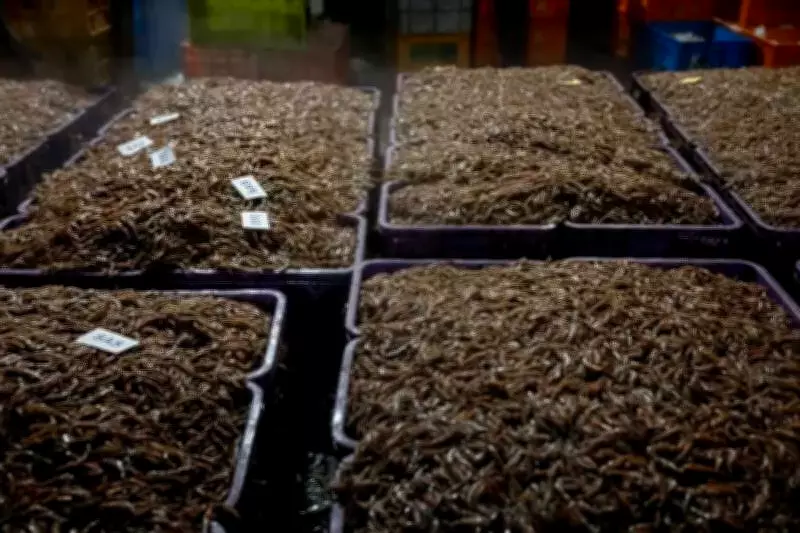
Deep-Sea Shrimp Trawling in Kerala Poses Severe Threat to Marine Ecosystems and Fishing Livelihoods
Scientists have issued a stark warning about the unchecked deep-sea shrimp trawling operations off the coast of Kerala, highlighting significant damage to marine ecosystems, fish stocks, and the livelihoods of local fishing communities. This alert follows the rare and first-ever confirmed discovery of a deep-sea telescope octopus in Indian waters, documented from the Laccadive Sea near Kollam.
Scientific Discovery Reveals Gaps in Monitoring and Regulation
The discovery of the telescope octopus (Amphitretus pelagicus), published in the Springer journal Russian Journal of Marine Biology, marks a scientific milestone. However, researchers emphasize that it exposes serious deficiencies in the monitoring and regulation of deep-sea fishing activities in Kerala. According to the study, deep-sea shrimp trawling typically results in 20-40% bycatch, which includes juvenile fish and non-target species, with bycatch levels soaring to 80% in some operations.
With annual landings of the main deep-sea shrimp species exceeding 2,000 tonnes, researchers estimate that between 500 and 1,300 tonnes of non-target marine organisms are discarded every year. This large-scale discarding threatens the long-term sustainability of fish stocks and could have cascading economic consequences for fishing communities, boat owners, and allied sectors dependent on marine resources.

Researchers Highlight Urgent Need for Action
P J Sarlin, head of the department of zoology at Fatima Mata National College in Kollam, who led the study, stated, "The discovery shows how little we know about our deep-sea marine ecosystems. The telescope octopus was not caught through a targeted operation but as bycatch. That itself is a warning. If fragile and rare deep-sea species are turning up when nets dredge through deep waters, it points to serious gaps in monitoring and management of deep-sea fishing."
The Amphitretus octopus is known for its transparent, gelatinous body and distinctive tubular eyes adapted for midwater life. Although it is listed as ‘Least Concern' on the IUCN Red List, the study noted that this classification reflects a lack of population data rather than confirmed security, particularly in Indian waters where deep-sea biodiversity remains poorly studied.
Long-Term Consequences and Calls for Regulation
Sarlin warned that the unchecked expansion of deep-sea shrimp trawling could have long-term consequences for marine ecology and livelihoods. "Marine ecosystems are extremely delicate and recover very slowly. Once the damage is done, it may be irreversible," she said.
Calling for stronger regulation, she stressed the need for systematic monitoring, regular bycatch assessments, and targeted deep-sea biodiversity studies. "We need a better balance between fishing and conservation. If we fail to act now, these resources and the livelihoods dependent on them could slip out of our hands," she added.
The study involved collaboration with Vyacheslav Bizikov, a marine biologist at the Russian Federal Research Institute of Fisheries and Oceanography in Moscow, and Lijin Kunnathully Gopi, a data scientist. Their findings underscore the urgent need for policy interventions to protect Kerala's marine environment and sustain its fishing industry.






