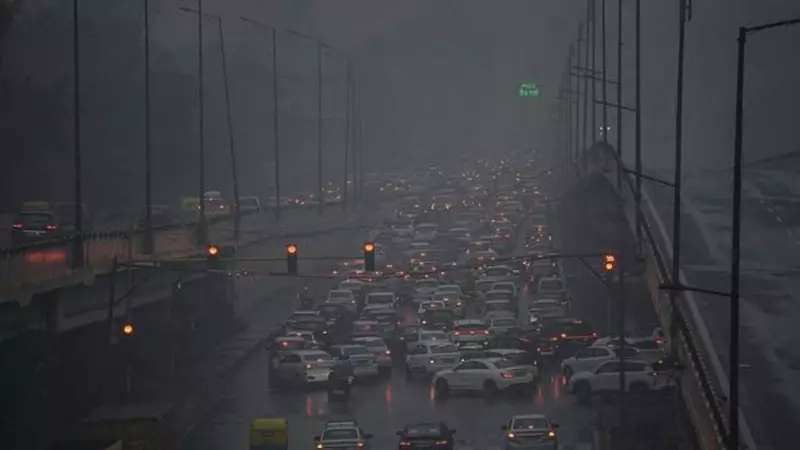
After enduring days of severe pollution, residents of Delhi finally experienced a breath of fresh air as rain and strong winds swept through the National Capital Region on Friday morning. This meteorological shift brought much-needed relief from the choking smog that had plagued the city for several days.
Significant Improvement in Air Quality
By 1 PM on Friday, Delhi's Air Quality Index (AQI) had improved to 278, placing it in the 'Poor' category. This marked a substantial improvement from Thursday's AQI of 322, which was classified as 'Very Poor'. Earlier in the week, the capital had suffered through two consecutive days of 'Severe' air quality, with AQI levels soaring as high as 440.
The positive trend extended across the National Capital Region. Noida witnessed its AQI drop to 268 from 335, while Gurgaon experienced a dramatic improvement, with AQI falling to 225 from 366 within just 24 hours.

Weather Conditions Behind the Change
The air quality improvement followed widespread rainfall and gusty winds across Delhi and surrounding areas. According to the India Meteorological Department (IMD), very light to light rain was reported at many locations in Delhi, accompanied by winds reaching speeds of 30-40 kilometers per hour.
Specific wind gust measurements included:
- Palam Airport recorded gusts up to 37 kmph
- Jafarpur experienced gusts up to 33 kmph
- Pragati Maidan and Salwan Public School station recorded gusts up to 31 kmph
Rainfall was recorded at several monitoring stations across the city:
- Palam received 12.6 mm
- Janakpuri recorded 12.5 mm
- Lodhi Road measured 11.8 mm
- Ridge station reported 11.4 mm
- Safdarjung received 8.6 mm
- Pitampura recorded 9 mm
Western Disturbance Drives Weather Change
Senior IMD officials attributed the weather transformation to an active western disturbance. This weather system typically brings moisture-laden winds from the Mediterranean region to northwest India during winter months, often resulting in rain, cloud cover, and strong winds.
The system also caused a significant increase in minimum temperatures across Delhi-NCR. Morning temperatures on Friday were 5-9 degrees Celsius higher than those recorded on Thursday, primarily due to increased cloud cover.
Several monitoring stations recorded particularly dramatic temperature increases by 5:30 AM:
- CRPF Campus recorded a jump of over 8 degrees Celsius
- Jafarpur saw an increase exceeding 8 degrees
- Lodhi Road experienced a rise of over 8 degrees
- Hindon recorded a similar temperature increase
Overall, Delhi's minimum temperature rose by approximately five degrees Celsius, settling at 13°C on Friday morning.
Varied Air Quality Across Monitoring Stations
While air quality improved overall, significant variations existed between different monitoring stations across the capital. Pusa recorded the cleanest air with an AQI of 179, placing it in the 'Moderate' category. In contrast, Wazirpur remained the most polluted area with an AQI of 328.
Several other stations reported 'Moderate' air quality, including:
- IGI Airport
- Lodhi Road
- Mandir Marg
- NSIT Dwarka
However, pollution levels remained elevated in certain areas, with several locations continuing to record AQI above 300:
- Nangloi
- Bawana
- Narela
- Patparganj
- Mayur Vihar
- Jahangirpuri
Forecast for Coming Days
According to predictions from the Indian Institute of Tropical Meteorology (IITM), the improved air quality is expected to persist through Saturday, remaining in the 'Moderate' category. However, conditions are forecast to deteriorate to 'Poor' on January 25, with air quality likely to fluctuate between 'Poor' and 'Very Poor' categories in the subsequent days.
The temporary relief from pollution comes as welcome news for Delhi's residents, who have been grappling with hazardous air quality levels throughout the winter season. The combination of rainfall and strong winds has provided a natural cleansing mechanism for the city's atmosphere, though experts caution that the improvement may be temporary without sustained efforts to address pollution sources.