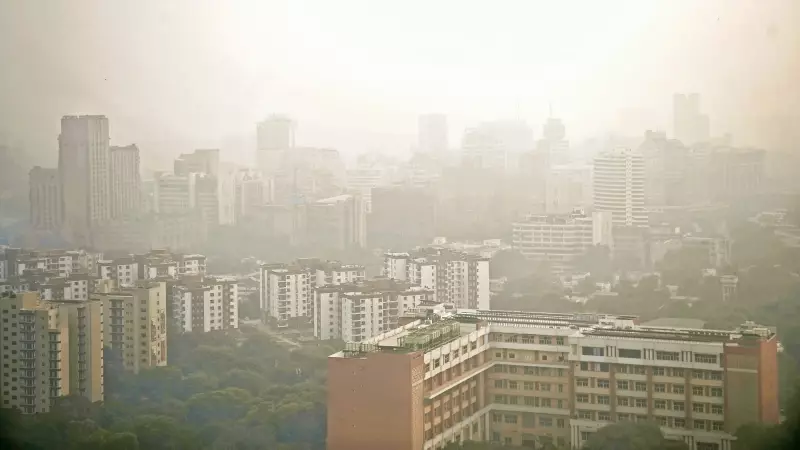
Delhi's Air Quality Turns 'Moderate' After 3 Months Thanks to Rain and Winds
In a rare and welcome development, Delhi's air quality improved to the 'Moderate' category on Saturday, marking the first such occurrence in over three months. According to data from the Central Pollution Control Board (CPCB), the Air Quality Index (AQI) stood at 184, a significant drop from Friday's reading of 282, which was classified as 'Poor'. This improvement is attributed to widespread rain and strong winds that swept across the National Capital Region (NCR) on Friday.
A Rare January Improvement
It is uncommon for Delhi to witness such a notable enhancement in air quality during January, as historical data from recent years suggests that the AQI typically fluctuates between the 'Poor' and 'Severe' categories in this month. Experts point to various factors, including winter conditions, thermal inversion, and calm winds, which often hinder the dispersion of pollutants, making this shift particularly noteworthy.
The last time Delhi experienced air quality in the 'Moderate' range was on October 13, 2025, when the AQI was recorded at 189. This recent improvement highlights the impact of meteorological conditions on pollution levels in the city.

Regional Variations and Short-Lived Respite
Neighboring areas also saw changes in air quality. Noida recorded a 'Moderate' AQI of 184, a sharp improvement from 270 the previous day. However, Gurgaon's AQI remained in the 'Poor' category at 225, nearly unchanged from 227 on Friday.
Unfortunately, this respite is likely to be temporary. According to the Indian Institute of Tropical Meteorology Pune's Air Quality and Weather Bulletin for Delhi, air quality is expected to remain in the 'Poor' category on Sunday, deteriorate to 'Very Poor' the following day, and improve marginally to 'Poor' on January 27. Over the subsequent six days, the AQI is projected to fluctuate between 'Poor' and 'Very Poor' categories, indicating ongoing challenges in maintaining cleaner air.
Weather Conditions and Their Impact
The improvement in air quality coincided with significant weather events. On Friday, Delhi experienced its first rain of the year, accompanied by a sharp drop in temperatures. The city recorded 19.8 mm of rainfall, making it the wettest January day in the last two years. The last time Delhi received higher rainfall in January was on January 30, 2023, with 20.44 mm.
The maximum temperature on Friday settled at 16 degrees Celsius, the lowest for the month since January 10, 2024, when the day's high was 15.2 degrees Celsius. These conditions were influenced by a western disturbance, seen as a cyclonic circulation over Jammu and adjoining Pakistan, persisting at about 3.1 km above mean sea level, according to the India Meteorological Department (IMD).
Future Outlook and Challenges
On Saturday, visibility dipped briefly, with Safdarjung and Palam stations reporting visibility of 400 metres in the early hours before improving. IMD forecasts indicate partly cloudy skies, gusty winds, and shallow to moderate fog over the coming days, with fluctuating temperatures. Another western disturbance is likely to affect Northwest India from January 26, conditions that could hinder pollutant dispersion and potentially worsen air quality again.
This episode underscores the delicate balance between weather patterns and air pollution in Delhi, emphasizing the need for sustained efforts to address environmental issues beyond temporary meteorological relief.