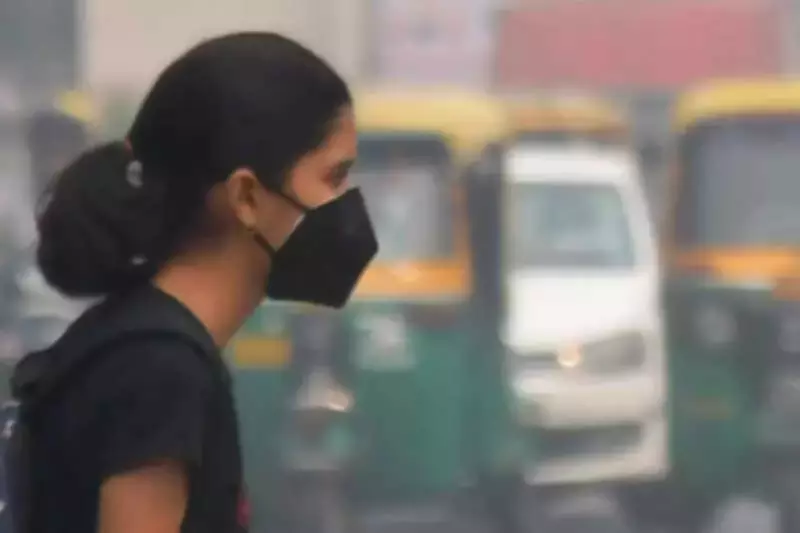
Delhi's Air Quality Worsens in January 2026 Despite Higher Rainfall
New Delhi witnessed a concerning environmental paradox this January. Despite receiving 33% excess rainfall compared to normal levels, the capital's air pollution situation deteriorated compared to the same period last year. According to an analysis of Central Pollution Control Board (CPCB) data, the average Air Quality Index (AQI) for January 2026 stood at 307, marginally higher than the 305 recorded in January 2025.
Severe Pollution Days Emerge in Mid-January
While January 2025 did not experience a single 'severe' pollution day (AQI above 400 on the 500-point scale), this year saw a troubling three-day spell of severe air quality from January 17 to 19. The pollution levels escalated dramatically during this period:
- January 17: AQI reached 400, at the extreme end of the 'very poor' category
- January 18: Pollution peaked at 440 AQI
- January 19: Levels remained dangerously high at 410 AQI
Most days during the first three weeks of January 2026 recorded persistently high pollution levels, creating hazardous breathing conditions for Delhi's residents.

Meteorological Factors Behind the Pollution Paradox
Professor Gufran Beig, founder of the System of Air Quality and Weather Forecasting and Research (SAFAR) and chair professor at the National Institute of Advanced Studies (NIAS), explained the complex meteorological dynamics at play. "Earlier studies indicated that La Niña conditions typically bring relatively faster winds during November and December," Beig noted. "If these conditions had materialized, Delhi's AQI would likely have improved, as stronger winds facilitate better dispersion of pollutants."
However, ENSO-neutral conditions persisted throughout January, preventing the development of faster wind patterns. These neutral conditions also meant that western disturbances were not intense during the beginning of the month, further limiting natural dispersion mechanisms. "Due to ENSO-neutral conditions, the western disturbances were not intense in the beginning of January, which did not help in the dispersion of pollutants," Beig elaborated.
Rainfall Provides Late Relief
The India Meteorological Department's data reveals a stark contrast in rainfall patterns throughout the month. While the city recorded only negligible rainfall of 0.01 mm on January 9, significant precipitation arrived later:
- January 23-24: 21 mm of rainfall
- January 28: Additional 4 mm of rainfall
This late-month rainfall proved crucial in improving air quality. "If there was no rain in the last week of January, this January may have seen a record high average AQI," Beig emphasized. "Rain caused a dip in AQI in the last week of January, leading to an improved average AQI."
An environmental expert highlighted the broader context: "This January was the wettest in four years, but the first three weeks were exceptionally dry. Due to high emissions from various sources, adverse meteorology could not provide any meaningful respite during that period."
Continuing Pollution Challenges and Weather Outlook
The pollution concerns extend beyond January. December 2025 was recorded as the most polluted December since 2018, with an average AQI of 349. November 2025 showed marginal improvement with an AQI of 357 compared to 375 in November 2024, though it remained firmly in the 'very poor' category.
Looking ahead, the India Meteorological Department has issued a yellow alert for the coming weekend, forecasting rain accompanied by thunderstorms, lightning, and gusty winds up to 40 kmph for both Saturday and Sunday. This weather system may provide temporary relief from the persistent pollution, though long-term solutions remain imperative for India's capital.