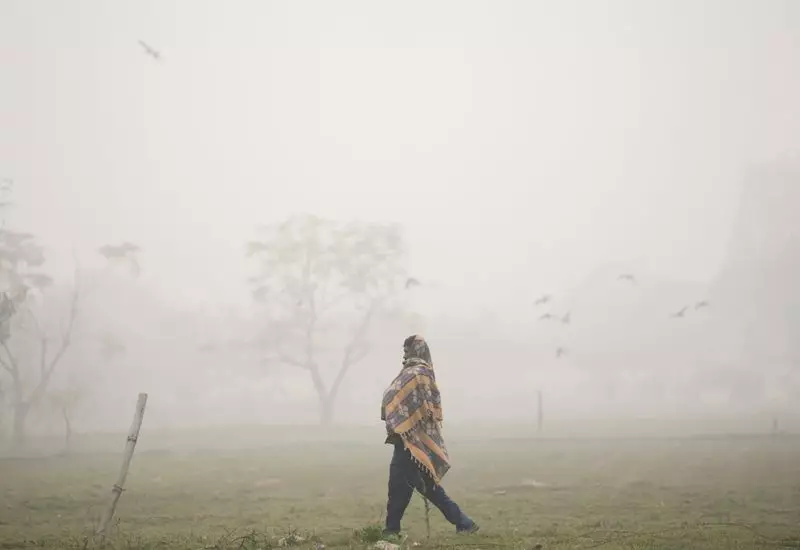
Residents of the national capital region woke up to a thick blanket of fog on Thursday morning, significantly reducing visibility and disrupting daily life. The India Meteorological Department (IMD) reported dense fog conditions, with visibility dropping to as low as 50 meters in some areas during the early hours.
Visibility Plummets, Travel Disrupted
The dense fog layer severely impacted road, rail, and air travel. At the Indira Gandhi International (IGI) Airport, several flights faced delays due to the low visibility conditions. The IMD's forecast had accurately predicted the foggy conditions, which are typical for this time of the year when temperatures drop and wind speeds remain low.
Commuters faced a tough time on the roads and highways connecting Delhi with neighboring cities like Noida, Gurugram, and Faridabad. The reduced visibility led to traffic snarls and prompted authorities to advise drivers to use fog lights and maintain low speed for safety.

A Slight Sigh of Relief on Air Pollution Front
Amid the foggy conditions, there was a marginal improvement in the city's notorious air pollution levels. The overall Air Quality Index (AQI) recorded by the Central Pollution Control Board (CPCB) was in the 'Very Poor' category. This marks a slight let-up from the 'Severe' and 'Severe Plus' categories that had gripped the city in the preceding days.
According to monitoring agencies, the average AQI hovered around the higher end of the 'Very Poor' band. While the shift from 'Severe' to 'Very Poor' indicates a minor improvement, the air quality remains hazardous for public health. Experts attribute this slight change to a moderate increase in wind speed, which helped in dispersing pollutants to some extent.
Authorities Monitor Situation, Forecast Mixed
The IMD and other weather monitoring bodies continue to keep a close watch on the situation. The forecast suggests that similar foggy conditions are likely to persist during the morning hours over the next few days, especially in pockets of Delhi and the wider National Capital Region (NCR).
However, the prediction for air quality remains a mixed bag. While the current wind patterns offer a temporary respite, meteorological conditions are expected to become favorable for pollutant accumulation again. The Commission for Air Quality Management (CAQM) is closely monitoring the AQI levels and has not yet revoked the Stage-III restrictions under the Graded Response Action Plan (GRAP), which were imposed earlier when the air quality turned severe.
Doctors and health experts have reiterated their advisory for vulnerable groups, including children, the elderly, and those with respiratory or cardiovascular conditions, to minimize outdoor exposure. Wearing N95 or KN95 masks outdoors is still strongly recommended despite the slight improvement in AQI readings.