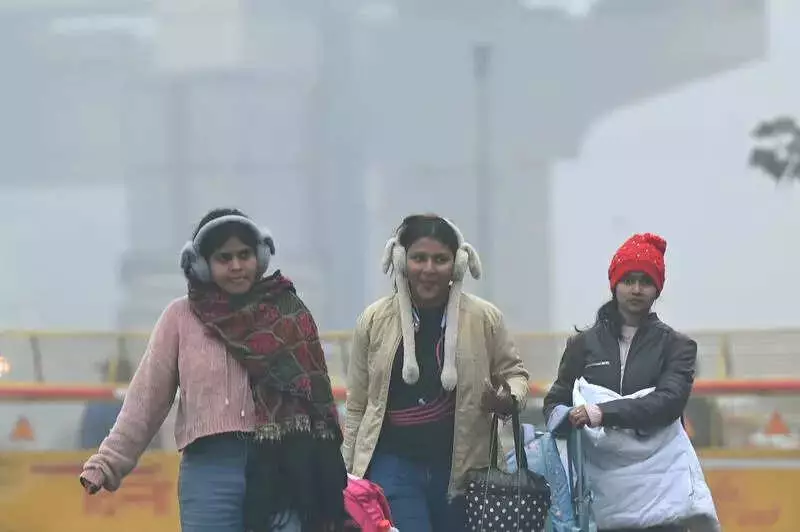
New Delhi remained engulfed in a thick blanket of fog on Monday, severely disrupting air and rail travel across the northern plains. While the city's air quality saw a marginal improvement, it stubbornly remained in the 'very poor' category, continuing the hazardous trend observed throughout December.
Travel Chaos and Hazardous Air
The dense to very dense fog led to significant operational nightmares at the Indira Gandhi International (IGI) Airport. Over 500 flights were delayed and 14 were cancelled due to the low visibility conditions. The situation was equally grim for rail commuters, with several trains running behind schedule by at least 30 minutes.
Visibility in the early hours plummeted drastically, with Palam recording a mere 150 metres. The 24-hour average Air Quality Index (AQI) registered at 373 (very poor) at 4 PM, slightly better than Sunday's 377 but still dangerously high. The average AQI for Delhi until December 22 stands at 350, far above the moderate range of 101-200.

Regulatory Action and Pollution Sources in Focus
Amid the ongoing crisis, the Commission for Air Quality Management (CAQM) in the National Capital Region held its 26th full commission meeting. The body reviewed existing measures and discussed tightening air pollution norms. A major point of deliberation was the issue of end-of-life vehicles.
The CAQM reiterated the Supreme Court's December 17 order, directing agencies to end protection for old, highly polluting vehicles. "Protection against coercive action continues for BS-IV and later emission-standard vehicles, while restrictions on taking action against highly polluting BS-3 and lower emission standard vehicles have been lifted," the commission stated, demanding strict compliance.
The meeting also ratified the revised Graded Response Action Plan (GRAP), modified as per Supreme Court directions. Authorities flagged construction and demolition waste as a persistent contributor to particulate pollution and called for stricter supervision. Progress on curbing vehicular pollution through cleaner mobility strategies was also assessed.
Weather Forecast and Historical Context
Meteorological forecasts offer a glimmer of hope regarding the fog but not the pollution. As the prevailing western disturbance weakens, wind speed is expected to pick up, which should gradually reduce the fog intensity until December 26. However, experts warn that the air quality is likely to remain in the 'very poor' range.
The current December's air quality paints a grimmer picture compared to the last year. Not a single 'moderate' AQI day has been recorded this month. In contrast, December 2022 saw six days of moderate air quality till December 22, and eight in the entire month. Delhi's average AQI for last December was 294, while it currently stands at 295 for the period till December 22 this year.
The India Meteorological Department (IMD) reported Delhi's maximum temperature at 21.8°C and the minimum at 11°C on Monday. A sharp dip is expected around Christmas, with the minimum temperature likely to fall to 6-8°C by December 25. Looking ahead, a feeble western disturbance is expected from December 28-31, which could again lead to low wind speeds and the potential return of dense fog.