

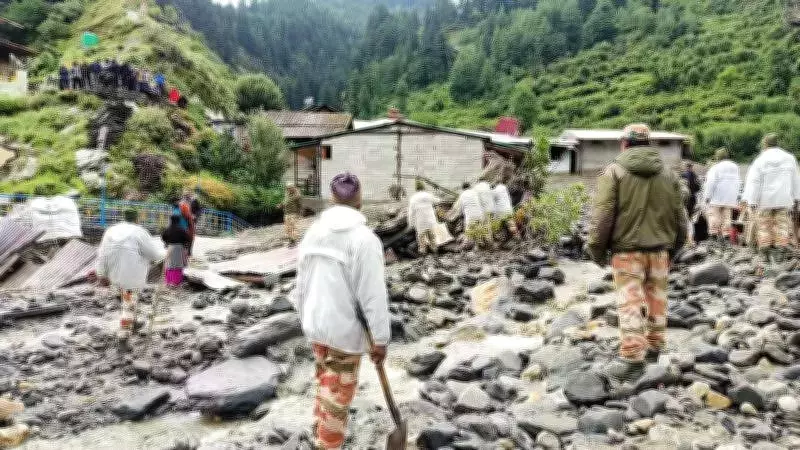
Dharali Flash Flood: Human Planning Failures, Not Nature, Caused Catastrophe
A comprehensive scientific assessment has concluded that the devastating flash flood that struck Dharali village in Uttarkashi district on August 5, 2025, was not primarily a natural disaster but a man-made catastrophe resulting from failed land-use planning and ignored warnings. The study, conducted by a multidisciplinary team of experts, reconstructs the event to reveal how human interventions turned a routine geomorphic process into a large-scale tragedy.
Scientific Reconstruction Points to Planning Failures
The assessment, published recently in the journal 'Current Science', was carried out by scientists and disaster experts from multiple government and academic institutions, including IIT Kanpur, the Geological Survey of India (GSI), the Uttarakhand State Disaster Management Authority (USDMA), and Doon University. Their findings indicate that poor land-use decisions—rather than an unpredictable natural anomaly—were the key factor in amplifying the disaster's scale.
The researchers emphasized that despite explicit warnings issued after the 2013 Kedarnath floods, which also affected the Kheer Gad channel feeding into Dharali, authorities failed to implement adequate preventive measures. The official response remained largely confined to short-term engineering solutions like retaining walls, without addressing the core issue of unregulated construction and settlement expansion within hazard-prone zones.

Rapid, Risky Construction Despite Repeated Warnings
Using satellite imagery and detailed field surveys, the study documented a dramatic increase in built-up structures in Dharali over the past decade. The number of buildings nearly doubled—from 89 in 2011 to approximately 160 by 2025—despite repeated alerts following the 2013 disaster. Much of this expansion occurred along debris-flow channels and flood-prone areas, placing homes and infrastructure directly in the path of future hazards.
"The Dharali disaster was not a purely natural phenomenon but a direct consequence of failed land-use planning," the study stated unequivocally. This unchecked growth significantly increased the village's vulnerability to natural processes that are inherent to the Himalayan landscape.
Geomorphic and Climatic Factors Compound Human Risks
While human actions played a central role, the experts also identified underlying geomorphic and climatic factors that shaped the disaster. Steep slopes, high relief, loose sediment, and intense rainfall created conditions conducive to debris mobilization. Scientists stressed that these are long-standing characteristics of the Himalayan region and must be rigorously accounted for in all planning and development decisions.
Climate variability is further compounding the risk, with short-duration, high-intensity rainfall events becoming increasingly frequent in the area. The study warned that such climatic shifts make traditional hazard channels far more dangerous when combined with expanding settlements, roads, and other infrastructure.
Event Sequence and Magnified Losses
The Dharali disaster was triggered by continuous rainfall that initiated a debris flow upstream, sending boulders, sediments, and water hurtling down the channel at high velocity. While such processes are a natural part of mountain systems, the study pointed out that dense habitation and infrastructure within the channel corridor dramatically magnified losses to life and property. The official death toll currently stands at four, with more than 50 people still missing.
A Cautionary Tale for the Himalayan Region
The authors asserted that Dharali should serve as a stark warning for other Himalayan towns and villages experiencing rapid, unplanned growth. The disaster exposed a persistent policy blind spot, where development pressures routinely override scientific risk assessments, and land-use regulations remain weak or poorly enforced.

The researchers issued a clear warning: without a fundamental shift towards science-based land-use planning, strict zoning regulations, and relocation from high-risk areas, similar disasters are likely to recur across the fragile Himalayan region. They called for immediate policy reforms to integrate disaster risk reduction into all developmental activities, ensuring that lessons from Dharali are not forgotten.





