

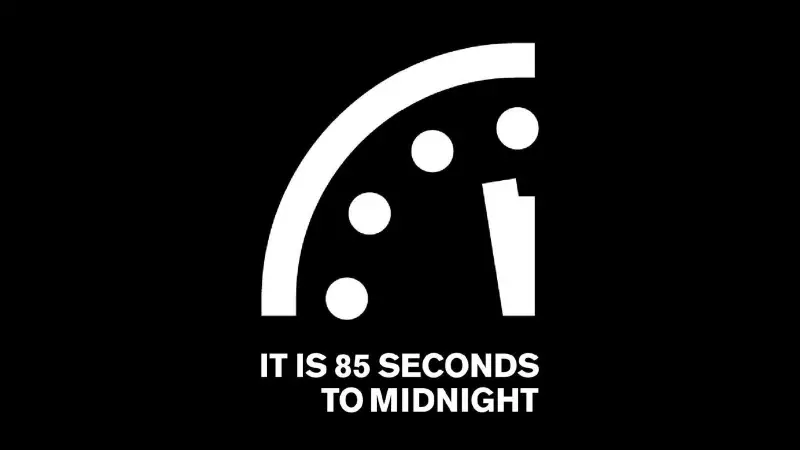
Doomsday Clock Advances to 85 Seconds Before Midnight: Humanity's Bleakest Assessment
In a stark warning to the world, scientists have moved the symbolic Doomsday Clock to just 85 seconds before midnight for 2026, marking humanity's closest approach to global catastrophe in modern history. This decision represents the most pessimistic assessment of our future since the clock's creation in 1947, reflecting escalating concerns over warfare, climate breakdown, emerging technologies, and the collapse of international cooperation.
Escalating Threats Outpace Solutions
The Bulletin of the Atomic Scientists, the nonprofit organization responsible for maintaining the Doomsday Clock, announced this alarming update on Tuesday. Founded by Albert Einstein and other eminent scientists after World War II, the group annually evaluates how close humanity stands to self-inflicted disasters that could threaten our survival, with midnight symbolizing global destruction.
"Catastrophic risks are rising, cooperation is falling, and time is running out," declared Alexandra Bell, president and chief executive of the organization. While emphasizing that the situation remains serious but not hopeless, Bell urgently called upon governments and citizens worldwide to demand immediate action before it becomes too late.

Multiple Crisis Factors Converge
According to the Bulletin's assessment, several critical factors have driven the clock's forward movement:
- Geopolitical Tensions: Major powers including the United States, China, and Russia are becoming increasingly antagonistic, nationalistic, and distrustful of one another. Long-standing agreements and shared norms that once reduced conflict likelihood are rapidly deteriorating, replaced by a dangerous "winner-takes-all" mentality in global politics.
- Military Conflicts: The organization highlighted several conflicts that heightened risks over the past year, including Russia's ongoing war in Ukraine, clashes between India and Pakistan in May, and military strikes by the United States and Israel on Iran in June. Each confrontation raises the alarming possibility of escalation involving nuclear-armed states.
- Climate Crisis: Scientists identified climate change as another major factor behind the clock's adjustment. National and global responses to the climate emergency remain profoundly inadequate, with recent United Nations climate conferences failing to commit strongly to phasing out fossil fuels or enforcing rigorous carbon emission monitoring.
From Cold War Anxieties to Contemporary Dangers
When first introduced during the Cold War's early stages, the Doomsday Clock primarily focused on nuclear weapon threats. Over decades, its setting has undergone numerous adjustments. Following the Cold War's conclusion and significant nuclear arms reductions by both the US and Russia, the safest moment occurred in 1991 when the clock stood at 17 minutes to midnight.
Since that optimistic period, the clock has steadily advanced again. In recent years, scientists have expanded their concerns beyond nuclear warfare to include climate change, biotechnology advances, and artificial intelligence's rapid development.
Progress Insufficient Against Growing Threats
The Bulletin acknowledged some encouraging developments, particularly noting that renewable energy sources like solar and wind power continued expanding rapidly in 2024. For the first time, renewable and nuclear sources together generated more than 40 percent of global electricity.
However, scientists emphasized that this progress remains far too slow to offset climate change's escalating damage. Efforts to combat global warming have been significantly hampered by policy decisions made by major economies.
Rising Nationalism Complicates Solutions
Speaking at the announcement ceremony, Daniel Holz, chair of the Bulletin's science and security board, warned that growing nationalism and authoritarian rule are making global problems increasingly difficult to solve. He stressed that humanity's greatest challenges require trust and cooperation across international borders.
"A world divided into 'us versus them' makes everyone less safe," Holz cautioned, highlighting how divisive politics undermine collective security.

With the Doomsday Clock now positioned closer to midnight than ever before, scientists deliver an unambiguous warning: humanity is rapidly running out of time to alter its current trajectory and avert potential catastrophe.





