The Enigmatic Dragon Hole: A Bending Underwater Archive
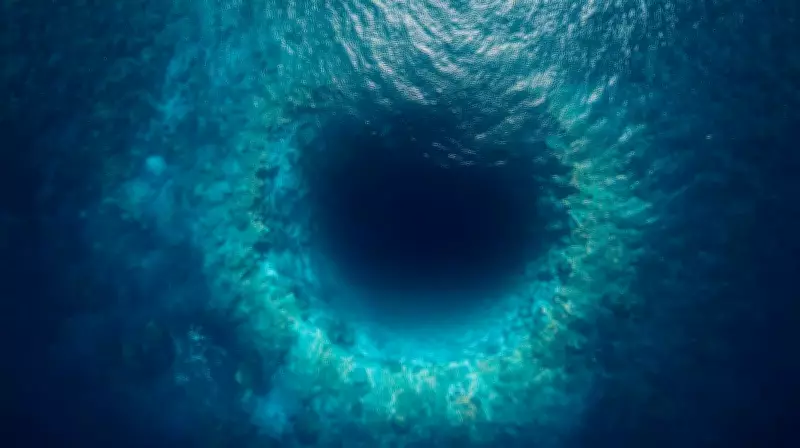
Blue holes represent some of the most mysterious formations on the ocean floor. From above, they often appear deceptively ordinary, blending seamlessly into surrounding reefs or open waters. Beneath the surface, however, these features plunge dramatically into darkness, creating environments that change rapidly with depth.
A Record Holder No More, But Still Scientifically Priceless
The Sansha Yongle Blue Hole, famously called the Dragon Hole, has captivated researchers in the South China Sea for over a decade. Once confirmed as the deepest known blue hole at precisely 301.19 meters, it has since been surpassed by a deeper site discovered in Mexico. Despite losing this distinction, the Dragon Hole remains one of the world's most intensively studied blue holes due to its unique structure, chemical properties, and remarkable isolation.
Scientists increasingly view this formation not as a mere depth record holder but as a natural archive meticulously shaped by time, water movements, and climatic changes throughout millennia.

Complex Architecture: Not a Simple Vertical Shaft
One of the most surprising discoveries about the Dragon Hole is its non-linear architecture. Detailed underwater surveys reveal that the hole bends and tilts significantly as it descends. The deepest point actually lies more than 100 meters horizontally displaced from the surface entrance.
The opening appears wide near the top but narrows sharply at intermediate depths before expanding again in certain sections. This irregular, complex morphology suggests a long evolutionary history involving multiple geological events rather than a single collapse event.
Technological Triumph: Mapping the Unmappable
Early measurement attempts faced substantial challenges due to the hole's twisting geometry. Turning walls and steep angles consistently confused conventional positioning systems, making accurate mapping nearly impossible for years.
In 2017, researchers achieved a breakthrough using a sophisticated underwater robot equipped with precision navigation instruments. This advanced technology enabled the first comprehensive three-dimensional mapping of the interior, confirming the exact depth through multiple cross-verified measurements.
Geological Time Capsule: Stone Walls Reveal Ancient Shorelines
The rock formations inside the Dragon Hole tell a compelling geological story. Distinct ledges and step-like features appear at specific depths, corresponding to ancient sea levels from colder periods when oceans stood significantly lower.
The hole appears to have developed in distinct stages, expanding and reshaping as global water levels fluctuated over geological time. Reef limestone dominates the walls, punctuated by unexpected side cavities that appear without warning.
Chemical Stratification: The Oxygen Disappearance Zone
Perhaps the most dramatic transformation occurs not in physical structure but in chemical composition. Below approximately 90 to 100 meters, oxygen concentrations drop to nearly undetectable levels.
Above this boundary, some marine life persists, but below it, conditions become stagnant and hostile to most organisms. The water circulates minimally with the surrounding sea, creating layers where oxygen gets consumed without replacement. In deeper zones, hydrogen sulfide becomes detectable, creating additional biological barriers.
Scientific Treasure: Preserved Chemical Signals
This limited circulation gives the Dragon Hole exceptional scientific value. Water layers remain largely undisturbed, preserving chemical signatures that reflect historical ocean conditions. For researchers, this isolation provides a rare opportunity to study environmental changes that unfolded gradually over centuries without the constant mixing that occurs in most marine environments.
The Dragon Hole continues to serve as a natural laboratory where scientists can decode the ocean's past, offering insights into climate patterns, sea level changes, and geological processes that have shaped our planet over millennia.