Egypt's Valley of Whales: 40-Million-Year-Old Fossils Reveal Evolution Secrets
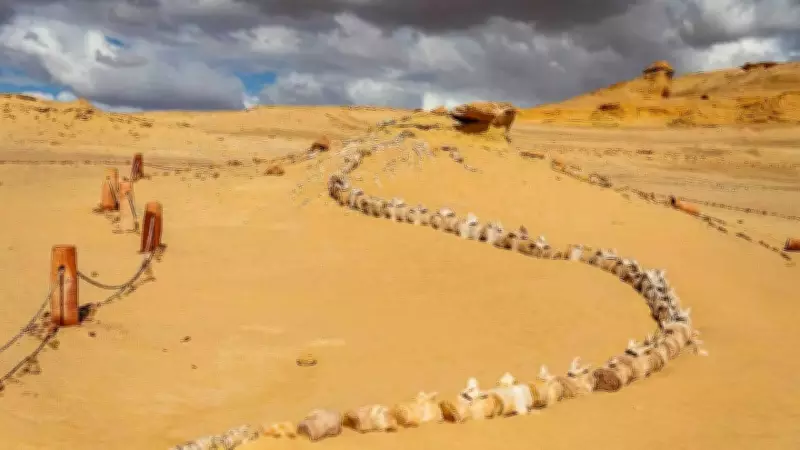
In the heart of the Egyptian Desert, Wadi Al-Hitan, known as the "Valley of the Whales," presents a surreal landscape where fossilized whale skeletons lie exposed beneath the relentless sun. Their vertebrae stretch across the sand in long, curved lines, creating an illusion as if the sea had only recently receded from this arid expanse.
From Ancient Sea to Modern Desert
How did these sea giants end up in such an extremely dry place on Earth, which contains hundreds of marine fossils dating back 40 million years? The answer lies in geological history. What appears today as a barren desert was once a shallow, warm sea that teemed with marine life during the Eocene epoch. Unlike modern whales, some of these ancient species possessed small but distinct hind limbs, offering a glimpse into their evolutionary past.
These fossils carry one of the most significant stories of evolution ever uncovered. Their anatomy reveals a gradual transformation from land mammals to the sea giants we recognize today. Located in the windswept Fayoum region, the rocks of Wadi Al-Hitan preserve compelling evidence of a thriving marine ecosystem that flourished millions of years ago.

The Formation of Wadi Al-Hitan
The presence of whale fossils here is not a mystery but a matter of geological time. Approximately 40 million years ago, northern Africa was submerged under the ancient Tethys Sea. This shallow, warm body of water supported a massive marine ecosystem. When these marine animals died, their bodies settled on the seabed and were gradually buried by sediments, leading to their remarkable preservation.
In 1989, a groundbreaking study published by the Geological Society, involving researchers from the University of Michigan and the Egyptian Geological Museum, uncovered skeletons of early whales such as Basilosaurus and Dorudon. This discovery has been instrumental in helping scientists understand the evolutionary journey of whales.
The Ancient Whales of Wadi Al-Hitan
Among the most striking creatures identified in the Egyptian fossil records is Basilosaurus, a massive marine predator that dominated prehistoric oceans. In 2005, paleontologists uncovered a nearly complete and remarkably preserved Basilosaurus isis skeleton, reaching up to 18 meters in length. While it matched some modern whales in size, it differed significantly in build and behavior.
This ancient whale had a long, thin, nearly serpentine body equipped with sharp teeth designed for active predation. The structure of its skull demonstrates forward-facing eyes and sophisticated hearing adaptations, essential traits for surviving in marine environments. Due to the exceptional preservation and scientific importance of these fossils, Wadi Al-Hitan was added to UNESCO's World Heritage List, recognizing its global significance.
Why Wadi Al-Hitan Remains Crucial for Science
Wadi Al-Hitan continues to be an active center of paleontological research rather than a static fossil reserve. Today, the area functions as an open-air museum where visitors can directly observe these fascinating witnesses to evolution. Ongoing expeditions frequently uncover additional skeletal fragments, marine reptiles, and microfossils that help scientists reconstruct the broader Eocene ecosystem.
The World Heritage property is a strictly protected zone, set within the wider landscape of the attractive Wadi El-Rayan Protected Area. These discoveries have helped shift scientific attention toward the African fossil record, expanding our understanding of early whale evolution and the dynamic history of life on Earth.