European Union Imposes Terrorist Label on Iran's Revolutionary Guard
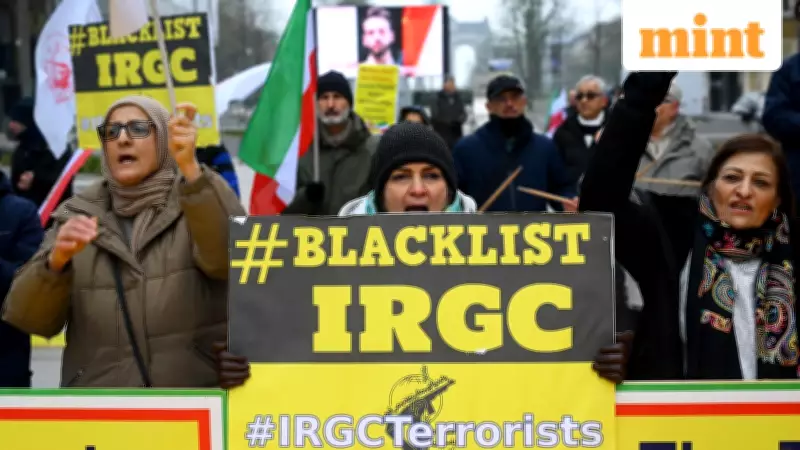
In a significant diplomatic escalation, European Union foreign ministers have unanimously agreed to designate Iran's Islamic Revolutionary Guard Corps (IRGC) as a terrorist organization within the bloc's official listings. This landmark decision represents Brussels' strongest response yet to Tehran's violent suppression of nationwide protests that have rocked the Islamic Republic.
Official Confirmation and Sanctions Announcement
EU foreign policy chief Kaja Kallas publicly confirmed the decision on Thursday, January 29, through a post on social media platform X. "EU Foreign Ministers just took the decisive step of designating Iran's Revolutionary Guard as a terrorist organization," Kallas declared. "Any regime that kills thousands of its own people is working toward its own demise."
Alongside the terrorist designation, EU diplomats revealed that foreign ministers have adopted a fresh round of targeted sanctions. These measures specifically address individuals and entities connected to both the repression of domestic protests and Iran's military support for Russia in ongoing conflicts.

French Support and Comprehensive Targeting
French Foreign Minister Jean-Noel Barrot detailed that the new sanctions encompass multiple sectors of Iranian authority:
- Members of Iran's government and judiciary
- Police officials involved in protest suppression
- IRGC commanders and personnel
- Entities responsible for internet censorship and digital repression
"It's important that we send this signal that the bloodshed that we've seen, the bestiality of the violence that's been used against protesters, cannot be tolerated," emphasized Dutch Foreign Minister David van Weel during the deliberations.
Protest Crackdown Fuels European Momentum
The EU's decisive action follows Iran's brutal nationwide crackdown earlier this month, which human rights organizations estimate resulted in thousands of civilian deaths. This violence dramatically increased pressure within European capitals to take concrete measures against Tehran's security apparatus.
While some EU member states had previously advocated for listing the IRGC, others exercised caution, concerned that such designation might undermine diplomatic engagement with Iran and potentially endanger European citizens within the country. Notably, France and Italy—which had initially resisted the terrorist label—threw their political weight behind the measure this week, ensuring unanimous approval.
Diplomatic Channels to Remain Operational
Despite concerns in several EU capitals that the terrorist designation could trigger a complete breakdown in relations with Iran, Kallas assured that diplomatic contacts would continue. "The estimate is that still the diplomatic channels will remain open, even after the listing of the Revolutionary Guards," she informed reporters following the ministers' meeting.
Understanding the Islamic Revolutionary Guard Corps
Established following Iran's 1979 Islamic Revolution to protect the Shi'ite clerical system, the IRGC functions as the Islamic Republic's ideological military force. Its primary mandate involves defending the regime from both internal dissent and external threats.
The Guards exercise enormous influence across multiple spheres:
- Controlling substantial portions of Iran's economy
- Commanding significant elements of the country's armed forces
- Overseeing Iran's ballistic missile and nuclear programs
- Extending deep into political and social structures domestically
Known domestically as the Pasdaran or Sepah, the organization is currently led by General Mohammad Pakpour, who was appointed by Supreme Leader Ayatollah Ali Khamenei after his predecessor, Hossein Salami, was killed in an Israeli strike during the June 2025 conflict.
Human Rights Accusations and International Condemnation
Western governments and human rights organizations have long accused the IRGC of militant activities abroad and systematic rights violations within Iran. Amnesty International recently presented evidence indicating that both the IRGC and its volunteer paramilitary force, the Basij, participated directly in the deadly repression of protesters.

"The intolerable repression of the peaceful uprising of the Iranian people cannot go unanswered," Barrot stated while confirming France's support for the terrorist designation.
Protest Origins and Escalating Death Toll
Iran's latest protest wave ignited on December 28 following a sharp depreciation of the national currency, subsequently spreading nationwide into what activists describe as the most substantial challenge to the Islamic Republic since its establishment. According to documentation from the US-based Human Rights Activists Network, the government's subsequent crackdown has resulted in nearly 6,000 civilian fatalities, creating international outrage that ultimately propelled the EU's historic decision.