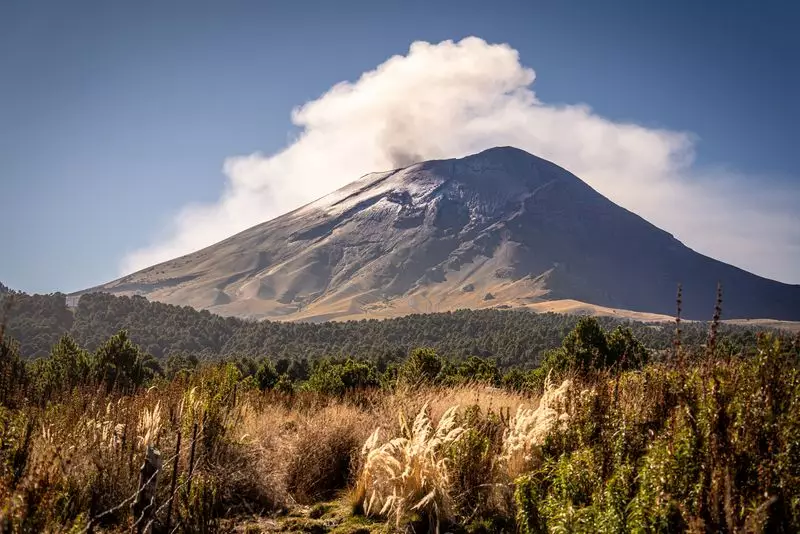
In a groundbreaking scientific achievement, researchers have successfully peered inside one of the world's most active and dangerous volcanoes. For the first time, a detailed three-dimensional 'CAT scan' of Mexico's mighty Popocatepetl has been created, revealing the intricate plumbing system that fuels its frequent eruptions.
A Revolutionary Glimpse Beneath the Crater
The ambitious project, led by an international team including scientists from the National Autonomous University of Mexico (UNAM) and the University of Bergen in Norway, utilized a cutting-edge technique known as muon tomography. This method is akin to medical X-ray imaging but on a colossal geological scale. It involves detecting muons—subatomic particles produced when cosmic rays interact with Earth's atmosphere—as they pass through the volcano. Denser materials, like rock, absorb more muons, while open conduits allow more to pass through.
By placing muon detectors around the flanks of 'El Popo', as the volcano is locally known, the team could map density variations inside the structure. The data, painstakingly collected and analyzed, has yielded the first-ever 3D visualization of the volcano's interior structure down to a depth of several kilometres. This is a monumental leap from previous two-dimensional or inferred models.

Mapping the Hidden Pathways of Magma
The 3D images have unveiled critical details about the volcano's internal architecture. Scientists can now see the configuration of the main conduit and identify potential secondary passages. The research, published in the journal Scientific Reports, confirms that the volcano's central crater connects to a main vent approximately 150 metres in diameter.
More importantly, the scan suggests the presence of other significant structural features. "We can see there is a conduit that goes directly from the surface to, let's say, the feeding chamber," explained Dr. Arturo Menchaca Rocha, a physicist at UNAM and a key figure in the study. This direct visualization helps validate and refine existing models of how magma ascends from deep reservoirs to the surface, driving eruptions.
The team deployed their muon detectors at various altitudes on the volcano's slopes, including a site near the Tlamacas mountain hut at an altitude of 3,950 metres. This strategic placement allowed them to capture data from different angles, building a composite and comprehensive internal picture.
Transforming Volcanic Hazard Assessment
The implications of this research extend far beyond academic curiosity. Popocatepetl, located just 70 kilometres from Mexico City and home to over 20 million people in its vicinity, represents a constant and severe threat. Its activity has intensified in recent decades, with frequent ash plumes, gas emissions, and occasional explosive events.
Understanding the exact shape, size, and condition of its internal conduits is vital for accurate eruption forecasting. "Knowing the structure of a volcano is essential to model the eruptive scenarios," the researchers emphasized. A clearer picture of the plumbing system allows scientists to better predict how gas and magma might behave during an unrest period. It can indicate whether an eruption is likely to be a slow lava flow or a violent explosive event, which dictates evacuation plans and emergency response.
This project, part of the larger Tomography of Muons of the Popocatepetl Volcano (TOMO) initiative, sets a new standard in volcanology. The success of muon tomography at Popocatepetl paves the way for its application at other high-risk volcanoes worldwide. It provides a non-invasive, powerful tool to 'see' inside geological giants, turning them from mysterious threats into mapped and monitored systems.
The work is ongoing, with plans to install more detectors to obtain even higher-resolution images. As Popocatepetl continues its rumbling activity, scientists are now equipped with an unprecedented internal blueprint, bringing the global community one step closer to mitigating the risks posed by these powerful natural phenomena.