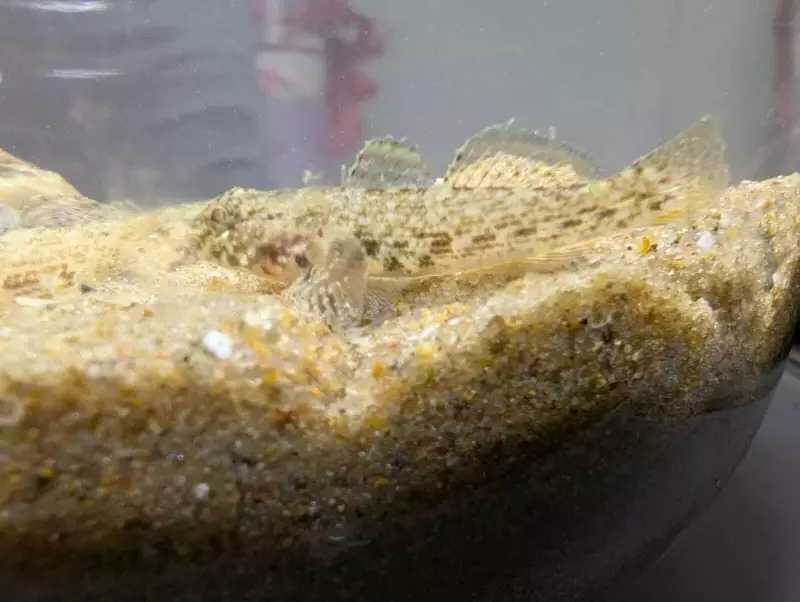
In a significant marine discovery, a team of scientists has recorded the presence of the goby fish, scientifically known as Bathygobius meggeti, in Indian waters for the very first time. The small fish was found in the sea near Gopalpur in Odisha's Ganjam district.
A First for Indian Marine Records
Senior scientist Anil Mohapatra from the Estuarine Biology Regional Centre of the Zoological Survey of India (ZSI) in Gopalpur confirmed the landmark finding. He stated that while this species has been documented in the Indo-West Pacific region, including areas like Japan, Australia, East Africa, and the Persian Gulf, its presence had never been confirmed in India until now.
The discovery process began in December last year when researchers collected three live specimens. These were gathered from the artificial rocky intertidal zone at Aryapalli, a village in Ganjam district primarily inhabited by fishermen. Following meticulous examination and study, the team conclusively identified the fish as the Meggitt’s goby (Bathygobius Meggitti), a species new to the Indian faunal record.

Scientific Significance and Published Findings
The research, led by Mohapatra, has been deemed biologically important and scientifically noteworthy. A formal report detailing the discovery from this coastal habitat in the Bay of Bengal was published in the National Academy Science Letters, an international journal, on Monday.
Describing the species, scientists noted it is very small in size and possesses a nearly cylindrical head that lacks scales. The finding underscores a broader ecological insight beyond just a new species record.
Artificial Habitats: Unexpected Havens for Marine Life
The researchers emphasized the emerging ecological importance of human-made rocky structures. Originally constructed as shoreline protection measures and breakwaters for port development to control coastal erosion, these artificial barriers have transformed over time.
They have evolved into permanent aquatic ecosystems, providing shelter, breeding sites, and feeding grounds for a variety of fish, invertebrates, and other marine organisms. The discovery of the goby fish in such a setting highlights the potential role of man-made coastal infrastructure in enhancing local marine biodiversity.
Smrutirekha Acharya, a senior research fellow and co-author of the article, explained that these small fish use the rocks for hiding and feed on algae or small invertebrates found there. They also form a crucial part of the food web, serving as prey for larger organisms. She stressed that the discovery from a small, artificial ecosystem points to the need for studying micro-habitats along coastlines to gain a better understanding of regional biodiversity.
According to Mohapatra, this finding offers useful insights for coastal management and habitat restoration strategies, demonstrating that engineered structures can inadvertently contribute positively to marine life.
The Research Team
The study was a collaborative effort involving several experts. The team included retired ZSI scientist Subhrendu Sekhar Mishra, ZSI scientist KK Bineesh, senior research fellow Rajesh Kumar Behera, senior zoological assistant TKS Thatachari, research associate Swarup Ranjan Mohanty, and Bhaskar Behera from Fakir Mohan University in Balasore.