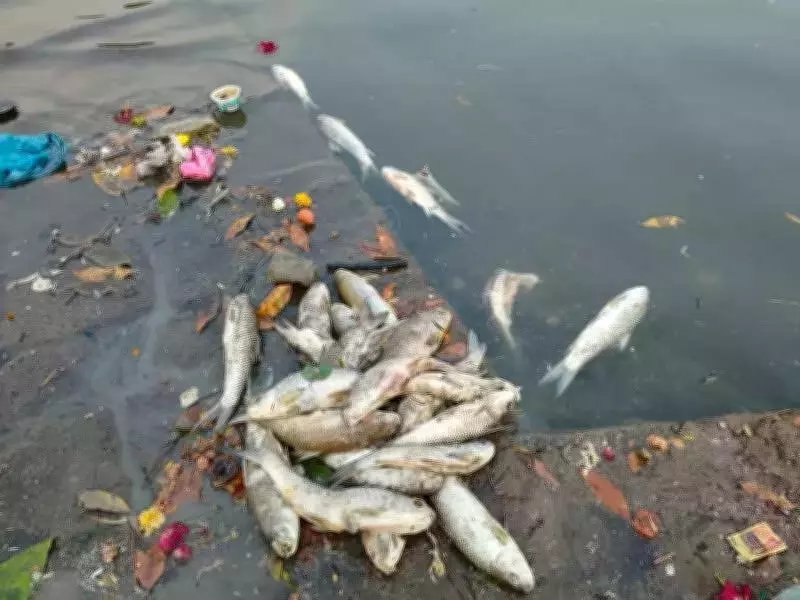
Mass Fish Deaths in Maharashtra Rivers Trigger Pollution Investigation
In a concerning environmental development, significant numbers of dead fish have been discovered along the banks of the Krishna and Warana rivers in Maharashtra's Sangli and Kolhapur districts. Environmental activists have pointed to toxic effluent discharged from upstream sugar mills as the primary cause of this ecological disaster.
Widespread Contamination Across Multiple Locations
Over recent days, residents have reported dead fish sightings at multiple ghats along the Krishna River in Sangli, including Sarkari Ghat, Mai Ghat, and Shankar Ghat at Sangalwadi. Similar incidents have been observed at Bhadole along the Warana River, which forms the boundary between Sangli and Kolhapur districts before merging with the Krishna near Sangli.
Sanjay Chavan, a Sangli-based environmental activist and president of Visava Tarun Mandal, provided detailed observations about the contamination sources. "The fish mortality results from a combination of sugar mill effluent and sewage discharge from Sherinala, a nullah flowing through Sangli," Chavan explained. "Additionally, laundry operators using chemical detergents at the ghats continue their activities without restriction, further polluting water that is subsequently extracted for drinking purposes."

Seasonal Pattern and Structural Factors
Chavan noted that these fish death incidents follow a predictable seasonal pattern, typically occurring between January and March, which coincides with the sugarcane crushing season when sugar mills operate at peak capacity. The activist identified specific river characteristics that exacerbate the problem.
"The dead fish concentrate mainly at river stretches with curvature and locations where barrages obstruct natural water flow," Chavan stated. "These structural barriers prevent proper water circulation, leading to dangerously high concentrations of pollutants in stagnant areas."
This annual recurrence has created persistent problems for local communities. The decomposing fish create foul odors along riverbanks, prompting local authorities to issue advisories recommending that residents boil water before consumption. Despite these warnings and the obvious environmental damage, activists claim no substantial action has been taken against the polluting entities.
Official Response and Water Quality Investigation
Pramod Mane, the Kolhapur regional officer of the Maharashtra Pollution Control Board, confirmed that authorities have initiated an investigation. "We have collected water samples from the affected areas for comprehensive laboratory analysis," Mane reported. "Once we identify the specific contaminants and their concentrations, we can determine the precise cause of the fish mortality and initiate appropriate action against responsible parties."
Broader Water Contamination Issues
The river pollution crisis extends beyond fish mortality to affect drinking water supplies in neighboring communities. In Ichalkaranji, a prominent textile town, residents received brackish water through their taps on Tuesday morning, with complaints indicating this contamination has persisted for three to four days.
Municipal authorities suggested that sewage water might be infiltrating drinking water pipelines through leaks in the distribution system. Abhijeet Patwa, an Ichalkaranji-based activist, described the broader water quality deterioration. "Contaminated water is being supplied across the city," Patwa asserted. "The Panchaganga River already exhibits foul odor and unpleasant taste due to stagnation, with low water levels preventing proper flow and natural purification."
Environmental advocates emphasize that these interconnected issues—industrial pollution, inadequate sewage treatment, and deteriorating river health—require coordinated intervention from multiple government agencies to protect both ecological systems and public health in the region.