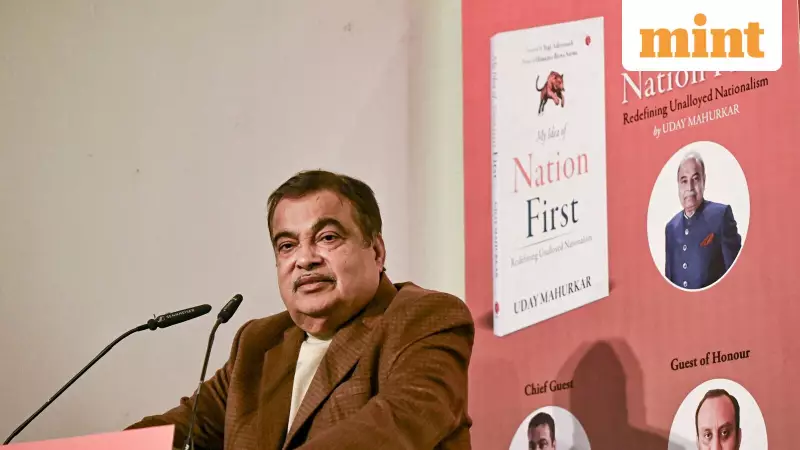
Union Transport Minister Nitin Gadkari has made a stark personal admission, revealing that the severe pollution in the national capital triggers allergic reactions in him whenever he stays in Delhi. The senior Bharatiya Janata Party (BJP) leader used his own experience to highlight the persistent air quality crisis gripping the National Capital Region (NCR).
A Minister's Personal Plight Highlights a National Crisis
Speaking at the launch of the book 'My Idea of Nation First: Redefining Unalloyed Nationalism' by journalist Uday Mahurkar at the Indira Gandhi National Centre for the Arts (IGNCA), Gadkari pointedly questioned the situation. "I live here for two days, (and) I get allergies because of this pollution. Why?" he asked. The 68-year-old minister, who represents Nagpur in Parliament and resides at Motilal Nehru Place during Delhi visits, framed the pollution issue as a question of nationalism.
Gadkari, who has held the portfolio of Union Minister of Road Transport & Highways since 2014, candidly accepted his ministry's significant role in the problem. "I am the transport minister and 40 per cent of pollution happens because of transport itself," he stated, referring to Delhi and its adjoining areas. He challenged the current reliance on polluting fuels, asking, "What kind of nationalism is this? Fossil fuels are limited, and pollution is increasing."

The Call for an Electric and Hydrogen Revolution
The minister pushed aggressively for a technological shift to curb the toxic emissions. "Can't we reduce fossil fuel usage? Why can't we promote electric vehicles and hydrogen-powered vehicles, which can lead to zero pollution?" he urged. Highlighting the economic burden, Gadkari noted that India spends a colossal ₹22 lakh crore annually on fossil fuels.
He showcased his personal commitment by speaking about his own eco-friendly flex-fuel vehicle, which runs entirely on ethanol. He emphasized that such alternatives can drastically cut pollution and reduce the nation's dependence on imported fuel.
Severe AQI and a Government Data Debate
Gadkari's remarks came on a day when Delhi's air quality deteriorated sharply, entering the 'severe' category with an AQI of 412, making it the second-most polluted city in India on that Tuesday. Noida, part of the NCR, was the worst with an AQI of 426. Forecasts predicted 'very poor' air quality would persist for the next six days.
This personal commentary from a senior minister arrives just days after the Union Environment Ministry presented a different perspective in Parliament. During the Winter Session, Minister of State Kirti Vardhan Singh told the Rajya Sabha that there is no conclusive data establishing a direct correlation between higher AQI levels and lung diseases. He was responding to a query from BJP MP Laxmikant Bajpai about studies linking Delhi-NCR's hazardous pollution to irreversible lung fibrosis among citizens.
This is not the first time Gadkari has expressed his apprehension about Delhi's air. In December last year, he had expressed reluctance to visit the capital, stating, "Every time, while coming to Delhi, I think whether I should go or not. Itna bhayankar pollution hai (The pollution is just terrible)." His latest comments reinforce a growing personal and political concern over an environmental challenge that shows no signs of abating.