

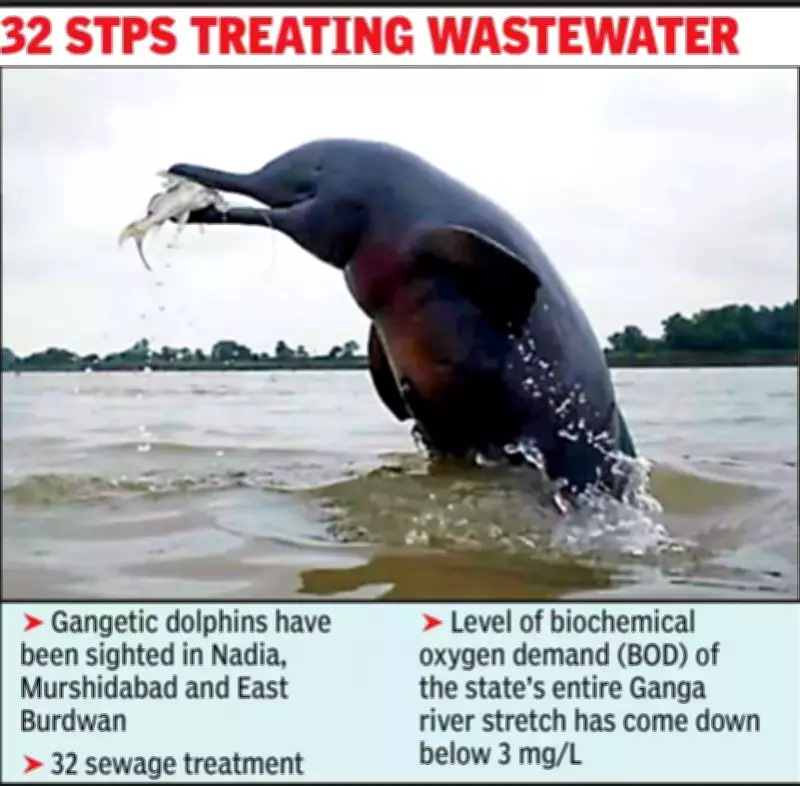
Gangetic Dolphin Sightings Herald Improved Water Quality in West Bengal's Ganga
Frequent sightings of Gangetic dolphins across various stretches of the river in West Bengal are being interpreted by officials as a clear indicator of improving water quality. Recent observations of these endangered mammals in districts like Nadia, Murshidabad, and East Burdwan have been directly linked to the state's concerted efforts under the Mission for Clean Ganga scheme.
Official Confirmation of Environmental Recovery
The resurgence of Gangetic dolphins in the Hooghly river underscores a remarkable enhancement in water quality, according to a senior government official. This positive development has been made possible through the continuous and dedicated efforts of the State Urban Development & Municipal Affairs Department, operating under the vigilant monitoring of the State Mission for Clean Ganga, West Bengal.
Infrastructure Investments Yielding Results
Over the past five years, significant infrastructure improvements have been implemented. Authorities report that 32 sewage treatment plants with an additional treatment capacity of 554 million litres per day have become operational to treat wastewater effectively. This substantial investment has led to measurable improvements in water quality parameters.

Government data reveals that the biochemical oxygen demand levels across West Bengal's entire Ganga stretch have now fallen below 3 mg/L. This represents a significant improvement compared to previous years, when BOD levels were recorded at 12 mg/L in 2018 and 8 mg/L in 2022, according to official statements.
Recent Operational Developments
Since April 2025, four additional sewage treatment plants have been put through trial runs and are now fully functional. These facilities are located at Maheshtala in South 24 Parganas, Raghunathganj and Jangipur in Murshidabad, and North Barrackpore in North 24 Parganas.
Officials confirm that the entire stretch of the Hooghly river from Farakka to Diamond Harbour, which covers nine districts along the river bank, has now been upgraded to the least polluted category. This classification reflects the substantial progress made in river conservation efforts.
Addressing Faecal Contamination
To further reduce faecal coliform levels in the river, authorities are implementing septage co-treatment at functional sewage treatment plants being established across riverside towns. A notable example is the recent operationalization of a 125 KLD functional STP at the regional wastewater management centre in Baidyabati, Hooghly.
This facility specifically treats septage from six nearby municipalities: Uttarpara-Kotrung, Konnagar, Serampore, Rishra, Champdani, and Baidyabati. Officials believe this infrastructure will contribute to further reductions in faecal coliform levels throughout the Ganga river system.
Broader Ecological and Economic Impacts
The increasing dolphin population is creating positive ripple effects beyond environmental recovery. According to a senior government official, the rising dolphin numbers are promoting tourism opportunities and enhancing local livelihoods in communities along the river banks. This ecological success story demonstrates how environmental conservation can yield both ecological and economic benefits for regional communities.






