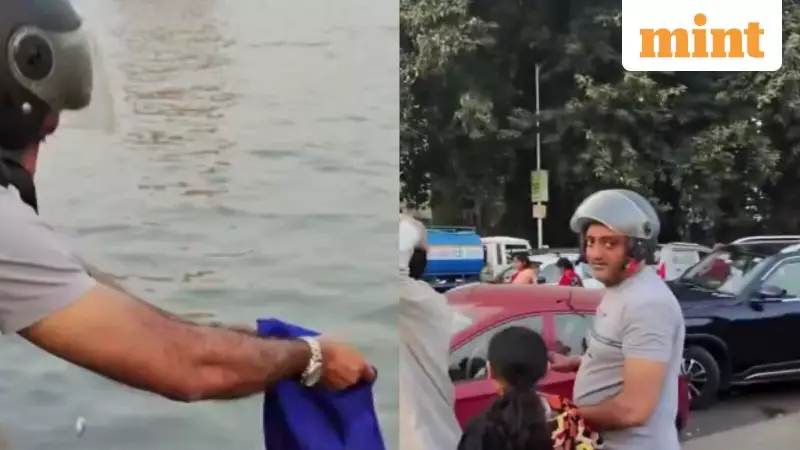
A short video clip captured near Mumbai's iconic Gateway of India has triggered a significant public discussion about civic behavior and environmental stewardship. The footage, which is circulating widely on social media platforms, shows a man allegedly discarding garbage into the Arabian Sea. A foreign tourist witnessing the act reacts with clear disapproval, highlighting the incident's embarrassing nature.
Video Details and Immediate Reaction
The video was originally shared on X by a user known as drunkJournalist. It depicts the tourist enjoying the waterfront view when a man approaches. This individual removes a bag from his car and proceeds to throw its contents directly into the sea. When confronted or questioned about his actions, the man offers no explanation or apology. He simply walks away from the scene.
The tourist is heard remarking that such behavior "is not good." This simple statement has resonated deeply with online audiences, amplifying the clip's impact far beyond its initial viewership.

Online Outcry and Public Shaming
The video has struck a powerful chord across social media. Users have expressed widespread embarrassment and frustration. Many commenters feel the incident, occurring at one of Mumbai's most famous landmarks and witnessed by an international visitor, exposes critical gaps in public awareness and law enforcement.
One user expressed a common sentiment of disappointment, writing, "I don't know when we Indians learn civics sense." This reflects a broader concern about the perceived lack of basic civic responsibility.
Another user proposed a stringent solution on X, suggesting, "Time for Blacklisting to be implemented in India. Indians only behave when they don’t have access to money. Blacklisting Indians who misbehave in and outside of India would remove access to any kind of credit for a period of a month. They would only have access to very basic living expenses for their family. It would work wonders for instilling civic sense into Indian people and would tidy up the country. Indians should also receive incentives for reporting other Indian people who misbehave like this."
A third user saw a positive angle, noting, "This is a good thing that videos are being made and people are being shamed. Let's hope it becomes a trend." This perspective views public shaming through social media as a potential deterrent for future misconduct.
Frustration over the perceived simplicity of the issue was also evident. One comment read, "How can these people be so stupid. This is so basic that no education, awareness is needed. Some things should be inherent. Itni bewakoof public kaise ho sakti."
Calls for Stronger Action and Enforcement
Many online discussions have shifted from mere criticism to demanding concrete consequences. A fifth user emphasized the need for decisive measures, stating, "This kind of blatant disregard for our environment needs swift and decisive action. While a fine is a start, the real deterrent will be a public shaming and a penalty that truly hurts. We need to ensure Mumbai Police and BMC don't just identify him, but make an example of him to prevent others from following suit."
Several other users pointed out that iconic public spaces like the Gateway of India require stricter monitoring and more effective deterrents. They argue for consistent enforcement of existing fines to prevent repeat offenses. While civic bodies like the Brihanmumbai Municipal Corporation (BMC) have taken action against littering in the past, the identity of the individual in this specific video remains unknown at this time.
The Underlying Challenge
This incident underscores a persistent and familiar challenge for Indian cities, especially at major tourist destinations. Keeping landmarks clean and pristine is not solely the responsibility of municipal authorities and police enforcement. It equally depends on the everyday behavior and sense of responsibility exhibited by the public and visitors.

The debate sparked by this video goes beyond a single act of littering. It touches on core issues of national pride, environmental consciousness, and the collective effort required to maintain public spaces. The conversation continues as people call for both personal accountability and stronger systemic measures to protect India's cultural and environmental heritage.