

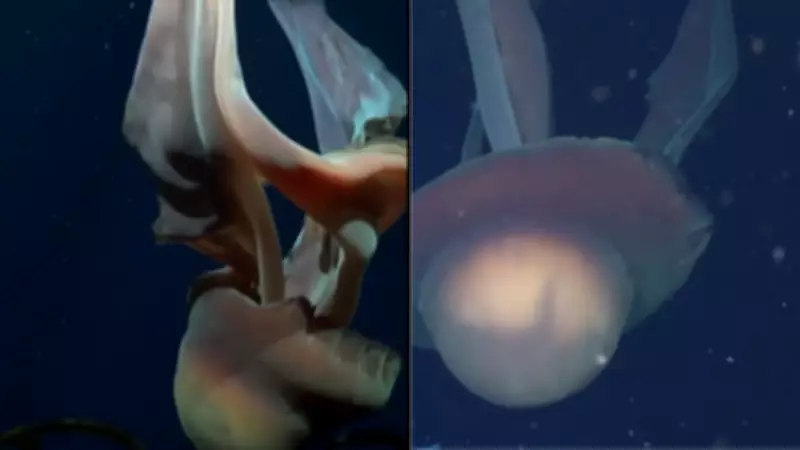
Rare Giant Phantom Jellyfish Filmed During Deep-Sea Expedition Off Argentina
In a remarkable deep-sea discovery, scientists have captured unprecedented footage of a giant phantom jellyfish swimming off the coast of Argentina. The stunning observation was made by researchers from the Schmidt Ocean Institute during a comprehensive survey of the region's underwater canyons.
Deep-Sea Encounter at 820 Feet
The extraordinary sighting occurred when a remotely operated vehicle recorded the elusive creature at a depth of approximately 820 feet. The exploration focused specifically on the Colorado–Rawson submarine canyon wall, where the research team was conducting detailed environmental assessments.
This particular jellyfish species is distinguished by its four exceptionally long arms, which can stretch up to an impressive 10 meters in length. The creature's bell can reach about one meter in diameter, making it roughly comparable to the size of a standard school bus.

One of Only 118 Sightings in 110 Years
What makes this discovery particularly significant is the extreme rarity of such encounters. Scientific records indicate only about 118 documented sightings of the giant phantom jellyfish over the past 110 years, making each observation a valuable contribution to marine biology.
The species is believed to inhabit oceans worldwide, with the notable exception of the Arctic Ocean. These mysterious creatures are known to thrive at astonishing depths, with some individuals living as deep as 22,000 feet below the ocean surface.
Unique Feeding Mechanism Without Stinging
Unlike many of its jellyfish relatives, the giant phantom jellyfish does not possess stinging capabilities. Instead, it employs four distinctive ribbon-like oral arms to capture its prey. These specialized appendages are thought to trap plankton and small fish before directing the food toward the creature's mouth for consumption.
Comprehensive Coastal Survey Reveals Biodiversity
The research expedition covered an extensive stretch of Argentina's coastline, ranging from Buenos Aires in the north to Tierra del Fuego in the south. The primary objective was to identify cold seeps—deep-sea locations where methane and other chemicals naturally escape from the seafloor.
These cold seep environments support unique microbial life that forms the foundation of specialized food chains, sustaining organisms including:
- Tube worms
- Mussels
- Clams
During their survey, the scientific team identified a particularly large cold seep area that spans nearly the size of Vatican City, demonstrating the scale of these underwater ecosystems.
Expedition Reveals Unexpected Marine Richness
"We were not expecting to see this level of biodiversity in the Argentine deep sea and are so excited to see it teeming with life," stated María Emilia Bravo, the expedition's chief scientist, in comments reported by BBC.
The research mission also documented an extensive coral reef formed by Bathelia candida, a stony cold-water coral species. This reef serves as a crucial habitat for various marine organisms including:
- Fish species
- Crustaceans
- Octopuses
While Bathelia coral has been previously recorded across the southwestern Atlantic Ocean, the reefs identified during this survey extend the known range of this species by approximately 600 kilometers further south than previously documented.
The discovery highlights the importance of continued deep-sea exploration and demonstrates how much remains unknown about marine ecosystems, even in regions relatively close to human civilization. Each expedition brings new insights into the complex web of life thriving in Earth's deepest waters.






