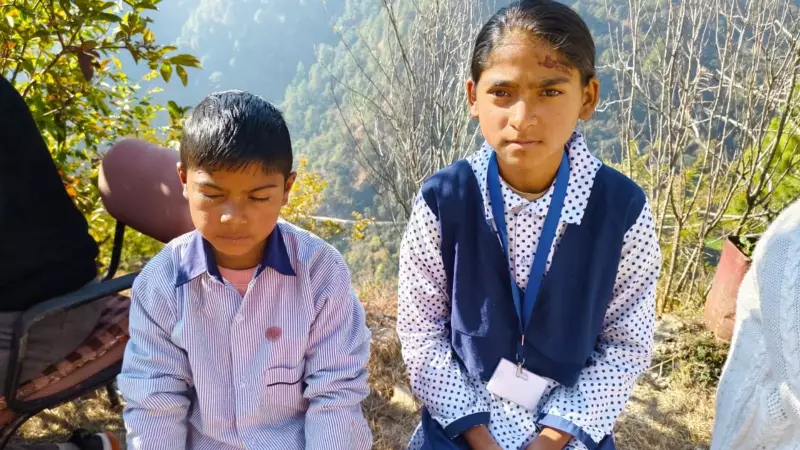
A terrifying bear attack at a remote government school in Uttarakhand's Chamoli district on Monday saw an 11-year-old boy dragged into the jungle by a cub, only to be rescued by the courageous intervention of his 12-year-old classmate. This incident marks the second such attack at the Harishankar Upper Primary School in Pokhari block within a span of just three days, raising serious alarms about escalating human-wildlife conflict in the region.
A Morning of Terror and Extraordinary Bravery
The students of Harishankar school, which has a total enrolment of only 12 pupils, had arrived about 15 minutes early. As they were cleaning the front yard, they spotted two bears—a female and her cub. While most children rushed into their Grade 7 classroom upon seeing the animals, 11-year-old Aarav Pundir and 12-year-old Divya Chaudhary were left outside.
"The adult bear moved towards the classroom while the cub grabbed Aarav and dragged him into the jungle behind the school," recounted their teacher, Upendra Sati. With no adults present to help, Divya Chaudhary displayed remarkable bravery. She chased the bear cub for approximately a hundred metres, her screams and pursuit forcing the animal to release Aarav.

The village headman, Bharat Chaudhary, narrated the harrowing scene. "The little brave girl ran after it, screaming. The cub let the child go, and we found him unconscious around 100 metres from the school. Divya was injured as she fell repeatedly and scraped her skin against the shrubs."
Recurring Threat and a Wider Crisis
This was not an isolated event. Just the previous Saturday, a bear had attacked the same school. On that occasion, three teachers managed to sound an alarm, preventing any harm to the children. In response, the block education officer had rescheduled the school's start time to 10 am on Monday, but the students had arrived early nonetheless.
Teacher Upendra Sati, speaking from the hospital in Pokhari where both children were admitted, expressed a grim observation. "It is as if the animals know there is easy prey." Aarav Pundir sustained injuries to his leg, hands, and head.
This incident is a microcosm of a severe and growing crisis in Uttarakhand. The state has recorded eight fatalities from bear attacks this year, the highest number since its formation in 2000, with 95 people injured. Additionally, leopard attacks have claimed 14 lives and injured 98 people. The Badrinath forest division has reported the highest number of bear attack deaths.
Root Causes: Climate, Habitat, and Human Activity
Wildlife officials and experts point to a confluence of factors driving animals into human settlements. Naval Kishore Negi, the Range Officer of Nagnath, noted that the village, situated 1,576 metres above sea level, has been experiencing warmer winters in recent years. He revealed this is the third major incident in his range, with bears now visiting the village instead of remaining in their habitats.
Authorities cite delayed hibernation periods, habitat loss due to ecological disasters, changing cropping patterns, and inadequate solid waste management as primary contributors. Forest department officials specifically highlight a shortened hibernation period for black bears at higher elevations, influenced by climate change.
Sambandam Sathyakumar of the Wildlife Institute of India has noted that in the Himalayas, less than 10% of bear habitat falls within protected areas, leading to frequent human-animal contact over space and resources. The extension of farmland, human encroachment, and habitat degradation further shrink the animals' living space.
Official Response and Community Anxiety
In the aftermath, the block education officer, Vinod Singh Matura, announced new safety measures. "We have asked the teachers to move to online classes for the next two days, after which the school will open from 11 am till 2 pm," he stated. The forest department has increased patrols, with two personnel now deployed specifically for the school area around 9 am.

However, the local community remains fearful. Village headman Bharat Chaudhary mentioned spotting bear cubs within the village, indicating breeding nearby. "They are breeding, and this will pose a threat to co-existence. We have requested the department officers to terminate them, but they have yet to respond to us positively," he said. Attempts to reach the Divisional Forest Officer of Kedarnath division, Sarvesh Dubey, for comment were unsuccessful.
The Asiatic black bear, native to regions from Jammu and Kashmir to the northeast, typically inhabits elevations between 1,200 and 3,300 metres. Their movements are heavily dictated by food availability, as they must store calories for hibernation. The current anomalies in their behavior, including attacks during what should be a deep hibernation period, underscore a rapidly changing and precarious interface between humans and wildlife in the Himalayan state.