

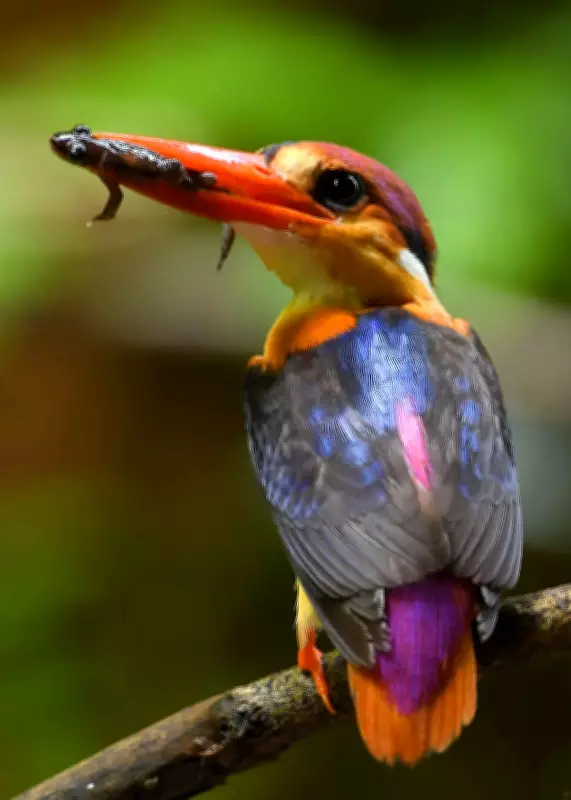
Goan Photographer's Groundbreaking Documentation of Oriental Dwarf Kingfisher Life Cycle
In a remarkable feat of wildlife observation, Goan bird photographer Shailendra Naik has successfully completed the first-known comprehensive documentation of the oriental dwarf kingfisher's complete life cycle within the state of Goa. This brilliant, partially migratory bird, scientifically known as Ceyx erythaca, typically nests in forested areas near streams or ponds where food is readily available.
Three-Year Observation Yields Unprecedented Insights
Naik's documentation spanned three continuous years, covering every aspect of the bird's existence around the clock. His meticulous work captured the entire process from mating through fledging, including the successful flight of twelve young kingfishers. The oriental dwarf kingfisher's elusive nature and preference for dense forest habitats near water bodies make continuous observation exceptionally challenging, with bird enthusiasts often resorting to paying local communities for access to nesting sites.
The journey began when Naik, already an enthusiastic amateur bird photographer, noticed a male oriental dwarf kingfisher constructing a nest in a mud retaining wall near an urban area in Ponda. Recognizing this rare opportunity, he immediately committed to documenting the bird's activities, employing two CCTV cameras alongside his photographic equipment to ensure comprehensive coverage without disturbing the natural behaviors.

Fascinating Reproductive Patterns Revealed
Over the three-year observation period, Naik documented one male oriental dwarf kingfisher mating with three different females, with each pairing producing four offspring annually. The reproductive cycle consistently occurred from late May through September each year. Naik's location in the foothills of the biodiverse Western Ghats proved ideal for this long-term study.
"Watching the life cycle of this tiny kingfisher unfold so close to home has been one of the most rewarding experiences of my life," Naik expressed. "Each year follows a similar pattern: the male attracts a female who first inspects the nest carefully. If she accepts the mating proposal, the male then arrives with prey to initiate the reproductive process."
Parental Behaviors and Survival Challenges
Naik's documentation revealed that both male and female oriental dwarf kingfishers participate equally in incubating eggs and caring for their young—a significant finding about this species' parenting dynamics. The fledging process proved particularly interesting, with parents employing strategic feeding patterns to encourage their offspring's first flight.
"The first flight of a hatchling is fascinating to observe," Naik explained. "The young birds receive ample nutrition during development but are deliberately starved when it's time for their inaugural flight. This occurs because hatchlings naturally hesitate to leave the nest. The parents hold prey in their beaks just outside the nest entrance, essentially coercing the young bird to venture out for its first flight."
Environmental Pressures and Nesting Strategies
The documentation wasn't without challenges, both for the photographer and the birds themselves. Snakes and monitor lizards regularly attempted to prey on the kingfisher eggs, drawn to the nest by the scent of gecko waste and other food remnants. Additionally, Naik noted that typically the fourth and final hatchling in each brood tends to be weaker and more difficult to train for flight.
The nest itself consists of a tunnel dug into the mud wall, leading to a main nesting chamber. Remarkably, the same nest structure was reused by the male bird in subsequent years with different female partners. The proximity to a water body significantly influenced the kingfisher's selection of this particular nesting location.

Ethical Documentation Methods and Conservation Implications
Naik emphasized the importance of non-invasive observation techniques. "To study these kingfishers without disturbing their natural behavior, I set up a CCTV camera near the nest. This allowed me to record their daily activities—from courtship to fledging—24 hours a day. I also took careful measurements of the nest tunnel and chamber. This non-invasive approach helped me gain deep insights into their behavior while ensuring the birds were never stressed or threatened. CCTV monitoring is the most ethical way to study shy species."
The photographer now anticipates another nesting chapter beginning in late May 2026. More importantly, his work has demonstrated a crucial conservation insight: "The entire process taught me that even small green patches in semi-urban areas can prove crucial for wildlife conservation," Naik concluded, highlighting the significance of preserving fragmented habitats for species survival.





