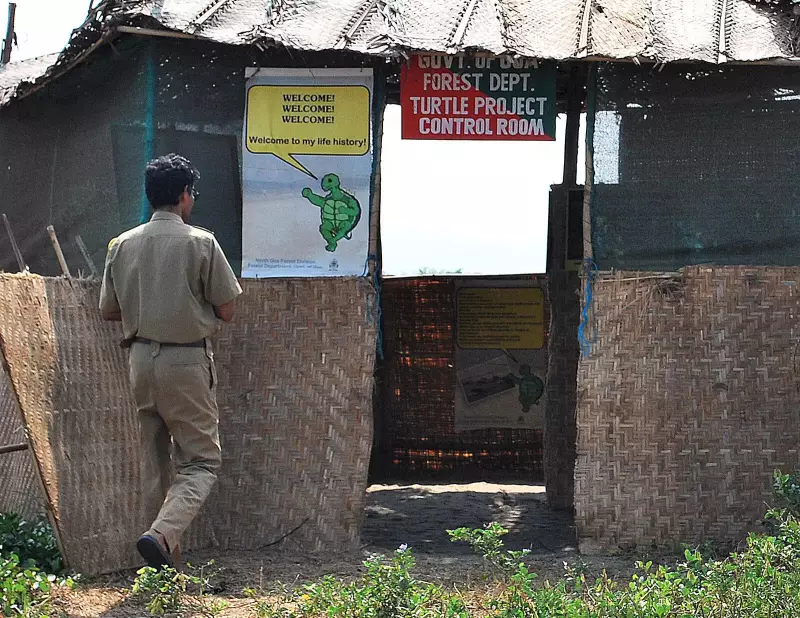
The new nesting season for the endangered Olive Ridley turtles has officially commenced along Goa's coastline. The season's first documented arrival occurred on the sands of Morjim beach in North Goa on the evening of December 26.
A Nighttime Arrival Marks the Season's Start
According to a forest guard stationed at the local turtle hatchery, the female turtle came ashore at approximately 9:30 PM. The process of digging her nest and laying eggs took between 30 to 60 minutes. After this crucial task was complete, she safely returned to the Arabian Sea, leaving behind a clutch of 99 eggs.
To ensure the eggs' protection from predators and human disturbance, volunteers from the state forest department carefully excavated them. The eggs were then transferred to a fenced and secure hatchery area managed by the department. "While the eggs were laid on the open Morjim beach, we moved them to the fenced zone for their safety," explained a forest volunteer involved in the operation.

Comparing Seasons and Addressing Challenges
This year's first nesting at Morjim shows a slight shift in timing. The volunteer noted that the first nest in the previous season was recorded on December 25, making this year's event a day later. Officials point to human activity as a potential factor in this delay. "Lights and loud music from beach shacks along this stretch cause disturbance to the turtles," the volunteer stated, contrasting it with the quieter Agonda beach in South Goa, where nesting typically begins earlier.
In fact, the nesting season in Goa has already begun further south. The first Olive Ridley turtle arrived at Agonda beach on December 11, which is 17 days earlier than its arrival in the last season. The general nesting window for these turtles in Goa spans from September to March.
Hopes for a Successful Hatching Season
Despite the minor delay at Morjim, forest department volunteers are optimistic about the 2025-26 nesting season. Turtles will continue to arrive to lay eggs until March. After an incubation period of 45 to 52 days, the hatchlings are released into the sea by the volunteers.
The volunteer at Morjim provided context from recent years: "Last season, we had 206 nests here. However, that was lower than the previous year, which saw 216 nests. The 2024-25 season was impacted by unpredictable weather, including unseasonal rainfall in February and March. We are hopeful for higher numbers this season."
Olive Ridley nesting is a nocturnal phenomenon, where only female turtles venture ashore during high tide. They dig deep, flask-shaped nests in the sand, often returning to nest multiple times in a single season. After covering the nest, the mother turtle leaves, and the hatchlings must eventually emerge on their own. While sporadic nesting occurs on many Goan beaches, Morjim, Mandrem, Galgibaga, and Agonda are the officially designated and protected nesting sites.