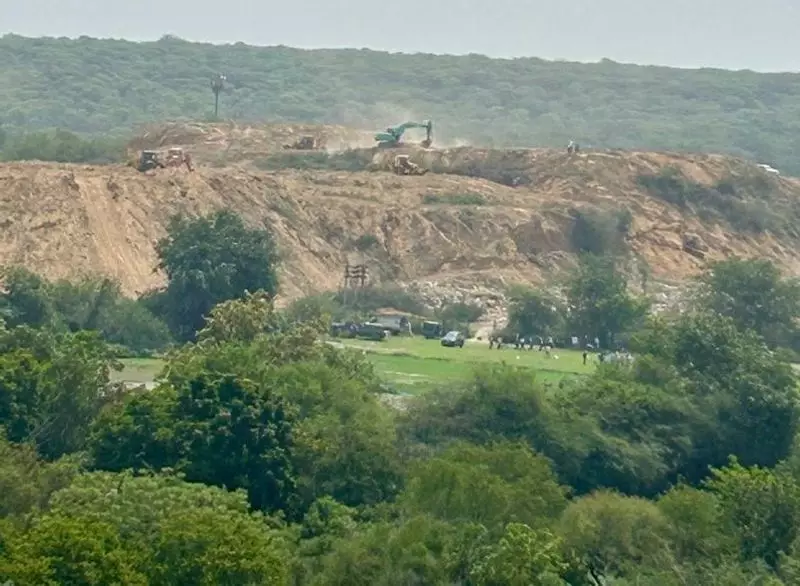
In a landmark decision aimed at environmental conservation, the Government of India has imposed a comprehensive ban on the grant of new mining leases across the entire Aravalli range. This significant move is coupled with a major expansion of the area designated as the Aravalli's 'Natural Conservation Zone' (NCZ). The decisions were ratified during a crucial meeting of the National Capital Region Planning Board (NCRPB) held on February 20, 2025.
Key Decisions from the NCRPB Meeting
The high-level meeting, chaired by Union Housing and Urban Affairs Minister Manohar Lal, resulted in two pivotal resolutions for the future of the Aravallis. The first and most direct action is the immediate prohibition on issuing fresh mining leases anywhere within the Aravalli mountain range. This ban is a decisive step to halt further degradation of the fragile ecosystem caused by excavation activities.
The second resolution dramatically expands the protective shield around the region. The area classified as the Aravalli Natural Conservation Zone (NCZ) will now be increased from the existing approximately 10,000 hectares to a sprawling over 22,000 hectares. This expansion more than doubles the land under strict conservation protocols, where activities like mining and large-scale construction are heavily restricted or prohibited.

Background and Legal Imperative
This proactive stance by the Centre is not born in isolation but follows a clear directive from the Supreme Court of India. The apex court had previously expressed grave concerns regarding illegal mining operations persistently eating away at the Aravalli landscape. The Court had explicitly instructed the Union Ministry of Environment, Forest and Climate Change (MoEFCC) to take definitive action to stop this environmental plunder.
The Aravalli range, one of the world's oldest mountain systems, acts as a crucial green barrier against desertification, guarding the fertile plains of north India, including the National Capital Region (NCR), from the advancing Thar Desert. It is also a vital groundwater recharge zone and a biodiversity hotspot. Years of unchecked mining have severely compromised its ecological functions, leading to depleted water tables, loss of wildlife habitat, and increased air pollution.
Implications and Future Enforcement
The ban on new leases and the NCZ expansion represent a strong policy shift towards preservation. The decisions are expected to have far-reaching implications:
- Halting New Encroachment: The mining ban directly addresses the root cause of fresh ecological damage, preventing new scars on the landscape.
- Enhanced Legal Protection: The expanded NCZ brings a much larger tract of land under stringent regulatory scrutiny, making unauthorized development significantly harder.
- Inter-State Coordination: The Aravallis span several states, including Haryana, Rajasthan, Gujarat, and Delhi. The NCRPB's decision provides a unified framework for these states to align their conservation efforts, ensuring a cohesive approach to protecting the entire range.
However, the challenge now shifts to rigorous enforcement. The success of this ban hinges on effective ground-level monitoring by state forest and mining departments to curb illegal mining that may continue under the radar. Furthermore, existing mining leases, which are not covered by this new ban, will remain a point of concern and require strict environmental compliance oversight.
Environmentalists and conservation groups have largely welcomed the Centre's decision, hailing it as a long-overdue measure to secure the future of the Aravallis. They emphasize that this must be the beginning of a sustained effort to restore already degraded parts of the range. The move underscores the government's recognition of the Aravalli ecosystem's critical role in the region's ecological security and its commitment to implementing the Supreme Court's mandate for its protection.