

Middle East Conflict Exposes Critical GPS Vulnerabilities in Persian Gulf
The escalating military confrontation between the United States, Israel, and Iran in the Middle East has triggered widespread and severe disruptions to Global Positioning System (GPS) signals across the Persian Gulf region. This technological breakdown is revealing the inherent fragility of global satellite navigation infrastructure during times of intense geopolitical conflict.
Bizarre Navigation Anomalies Emerge Amid Hostilities
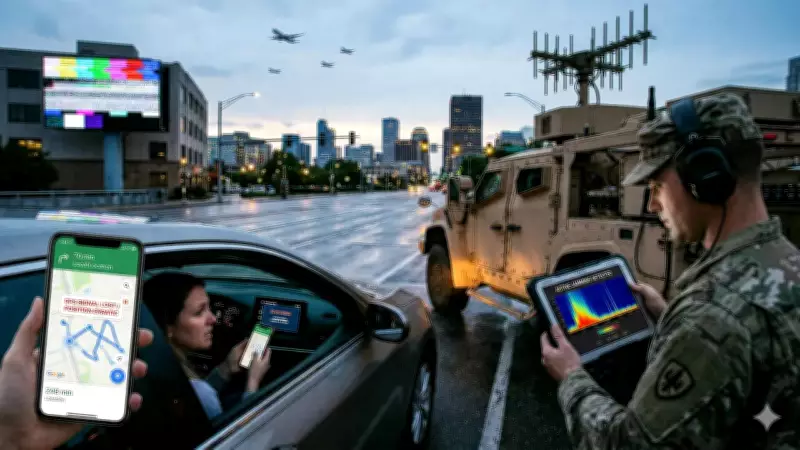
According to detailed reports from maritime and aviation tracking firms, within mere hours of the initial U.S. and Israeli strikes against Iranian targets on February 28, alarming irregularities began appearing in navigation data. Ships traversing the Persian Gulf were documented making sharp, unnatural polygonal turns that defy standard maritime routing. Even more strikingly, vessels have been recorded appearing to sail over landmasses on tracking systems, while commercial aircraft have been observed flying in erratic, wave-like patterns that bear no resemblance to their actual, intended flight paths.
On the ground in urban centers like Dubai, the GPS malfunctions have had tangible, real-world consequences. Food delivery riders, whose locations are tracked via smartphone apps, have been shown appearing far off the coast in the middle of the Arabian Sea, despite physically being on city streets. This widespread spoofing of location data has created a chaotic digital landscape where reality and reported positions are severely misaligned.

Scale of the Disruption: From Background Noise to Full-Blown Crisis
The volume of this interference is staggering. Maritime intelligence firm Windward logged that within the first 24 hours of the conflict's latest escalation, over 1,100 vessels across the Gulf experienced significant GPS interference. Analytics firm Kpler, which monitors global maritime movements, confirmed it is actively tracking the situation, noting the navigation system is under "severe and growing stress." A week after the initial strikes, the number of affected vessels had surged by an additional 55%, indicating a rapidly worsening problem.
While GPS manipulation in the Persian Gulf is not an entirely new phenomenon—oil tankers have historically spoofed their Automatic Identification System (AIS) signals to obscure movements and evade sanctions on Iranian oil—experts note the current scale is unprecedented. "What was once a background problem has become a full-blown crisis since hostilities broke out," stated Ana Subasic, a trade risk analyst at Kpler. The practice of spoofing, which involves broadcasting false location data, has transitioned from a tool of covert maritime operations to a widespread source of regional navigational chaos.
Deliberate Jamming or Collateral Damage?
The primary cause of this disruption, according to security analysts, appears to be deliberate signal jamming by Gulf states. Clayton Swope, deputy director of the Aerospace Security Project at the Center for Strategic and International Studies, explains that these nations are likely flooding the region with false GPS signals as a defensive measure. "The goal is to confuse the onboard systems of adversarial drones and missiles before they can reach their targets," Swope noted, highlighting a tactic to protect critical national infrastructure.
However, this defensive strategy creates significant collateral damage. When a region is saturated with false signals, all users of satellite navigation—commercial shipping, civil aviation, and everyday location-based services—become unintended victims. The situation mirrors disruptions recorded across Europe following Russia's invasion of Ukraine in 2022, where similar electronic warfare tactics degraded GPS reliability for civilian and commercial use.
The ongoing conflict starkly illustrates how modern warfare extends beyond physical battlegrounds into the electromagnetic spectrum, with satellite navigation systems becoming a key vulnerability. As hostilities continue, the reliability of the GPS network that underpins global trade, travel, and logistics in the strategically vital Persian Gulf remains in serious jeopardy.






