Gurgaon's Aravali Foothills to Feature Guided Nature Trails with Eco-Friendly Initiatives
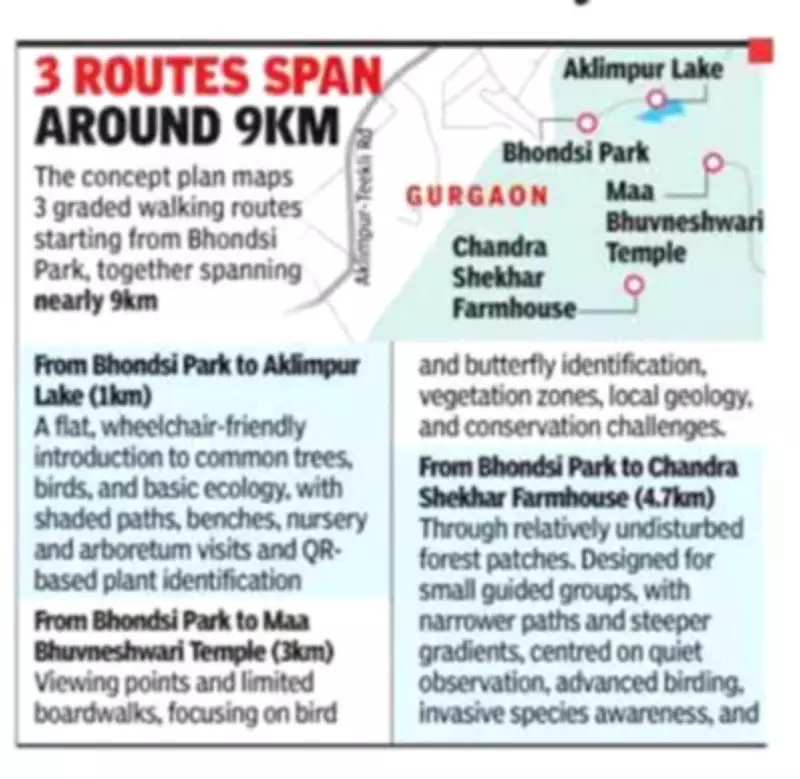
A detailed concept plan has been developed to establish guided nature trails in the foothills of the Aravali Hills near Gurgaon, aiming to enhance public access to natural landscapes amid the city's limited green cover, estimated at under 10%. The proposal outlines three graded trails totaling nearly 9 kilometers, starting from Bhondsi Park, with features such as licensed eco-guides, QR-based identification of common and medicinal plants, and color-coded routes for easy navigation.
Three Graded Trails for Diverse Experiences
The trails are designed to cater to different fitness levels and interests. The first route is a 1-kilometer loop connecting Bhondsi Park to Aklimpur Lake, designed as an easy, wheelchair-friendly introduction to common trees, birds, and basic ecological concepts. It includes wider paths, shaded stretches, benches, and minimal elevation change, with activities like basic birdwatching and QR-based plant identification.
The second trail extends 3 kilometers from Bhondsi Park to Maa Bhuvneshwari Temple, traversing varied Aravali foothill terrain with gentle inclines, viewing points, and small bridges. Guides will focus on vegetation zones, riparian features, and ecological interdependencies, with activities such as detailed bird and butterfly identification and photography at marked spots.

The longest route is a 4.75-kilometer trek towards Chandra Shekhar Farmhouse, passing through relatively undisturbed forest stretches with narrower paths and steeper gradients. This trail is intended for small guided groups, emphasizing quiet observation, advanced birding, animal tracking, and understanding invasive species and forest resilience.
Eco-Friendly Infrastructure and Community Involvement
All paths will be laid using natural, permeable materials like compacted earth and wood chips to limit erosion and maintain the forest character. Infrastructure will be minimal, with eco-friendly benches made from local stone or recycled wood, discreet bird hides, and viewing platforms. Safety measures include emergency contact signage, first-aid kits, and periodic trail checks.
Wayfinding will rely on color-coded routes, difficulty symbols, and directional arrows, with large orientation boards at trailheads displaying maps and visitor guidelines. Interpretive signage in Hindi and English will identify flora and fauna and explain ecological processes, supplemented by QR codes for deeper information via smartphones.
A key component is community participation, with residents from nearby villages to be trained as eco-guides and support staff through modules covering natural history, first aid, visitor management, and biodiversity monitoring. Training will also include local craft development and entrepreneurship skills, aligned with Haryana's Ecotourism Policy 2024, to create conservation-linked livelihoods.
Officials Emphasize Learning and Conservation
Conservator of Forests (South Haryana) Subhash Yadav stated that technical and financial proposals have been invited from agencies with experience in tourism and hospitality, with work to be initiated accordingly. The initiative is intended as a quiet learning corridor into the Aravalis rather than a commercial attraction, addressing Gurgaon's reduced access to natural landscapes due to rapid urbanization.
Additional features include drinking water refill stations to discourage plastic bottles, segregated waste bins, and plans for nocturnal walks and optional wilderness skills under expert guidance. The trails aim to foster environmental awareness and support sustainable tourism in the region.