

Gujarat Forest Department Implements Strict Ban on Feeding Monkeys and Langurs
The long-standing practice of casually tossing fruits, biscuits, and leftovers to monkeys and langurs near temples, housing societies, and open grounds in Gujarat is now facing severe legal repercussions. What was once considered routine or even charitable behavior has been officially recognized as a significant public safety threat, prompting the state forest department to take decisive action.
Legal Crackdown and Substantial Penalties
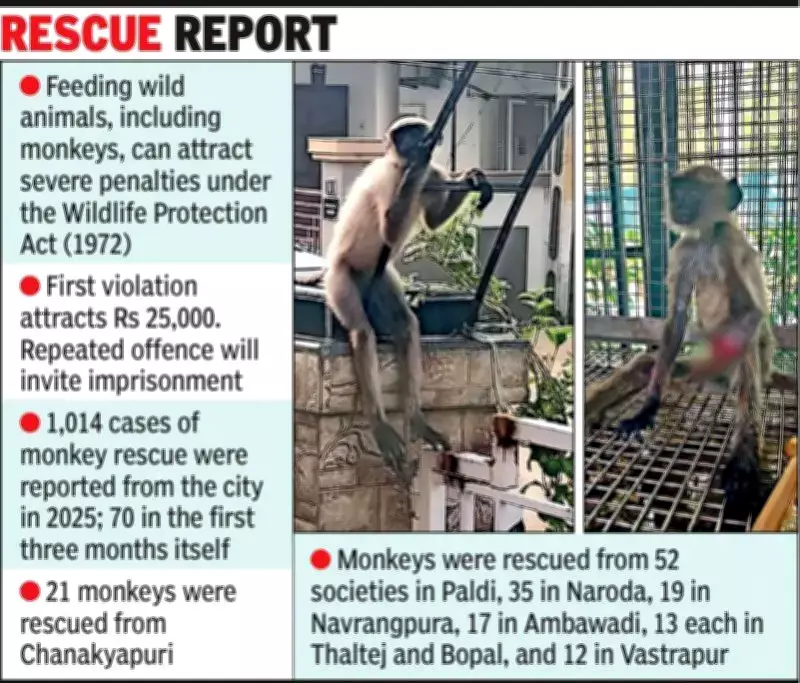
The Gujarat forest department has initiated a comprehensive crackdown on feeding primates, explicitly warning that this activity will now be treated as a serious violation under the Wildlife Protection Act. According to new enforcement measures, a first offense of feeding monkeys or langurs can result in a substantial fine of Rs 25,000. Repeated violations carry even harsher consequences, potentially leading to imprisonment for persistent offenders.
"Feeding encourages dependence and aggression, which leads to more conflict situations," emphasized Minal Jani, Deputy Conservator of Forest in Ahmedabad. The department has intensified both awareness campaigns and enforcement operations across urban areas, with rescue teams specifically instructed to monitor behavior in zones where primate aggression is escalating.

Escalating Urban Wildlife Crisis in Ahmedabad
Officials confirm that the situation has progressed beyond mere nuisance to become a genuine public safety concern. In Ahmedabad alone, emergency services now regularly field calls involving monkey bites, aggressive attacks, or primates invading homes in search of food. The scale of this urban wildlife challenge is substantiated by alarming official data.
During the December 2024 census, Ahmedabad's monkey population was recorded at 4,602 individuals, representing nearly double the count from just five years earlier. This dramatic increase correlates directly with changing animal behavior patterns influenced by casual feeding practices. Instead of merely passing through urban areas occasionally, monkeys have established permanent residences in empty plots, tree-lined colonies, and neglected grounds throughout the city.
Geographic Hotspots and Disturbing Incident Statistics
The forest department has identified 198 specific locations across Ahmedabad where monkey and langur presence constitutes a recurring problem. Among the worst-affected areas are:
- Vastrapur
- Navrangpura
- Thaltej and Bopal
- Ghuma and Ambawadi
- Paldi and Shahibaug
- Chandkheda and Kubernagar
- Naroda and Narol
- Sabarmati and Bilasiya
- Maninagar and Asarwa
In some particularly concerning pockets, the situation has reached alarming proportions. The Chanakyapuri area alone reported 20 separate incidents of monkey bites. Citywide, approximately 40 bite cases are documented monthly. A recent operation in Gomtipur was launched specifically to capture a monkey that had bitten 12 people within just five days.
Legal Framework and Behavioral Consequences
Under the Wildlife Protection Act of 1972, which was amended in 2022, both monkeys and hanuman langurs receive protected status under Schedule II. Feeding these animals is legally classified as baiting, constituting a serious offense with significant penalties. This legal interpretation reflects the understanding that casual feeding fundamentally alters primate behavior, creating dependency and increasing aggression toward humans.
The Human-Langur Interaction Survey has revealed the extensive scope of this challenge. Data from Ahmedabad's Wildlife Rescue Center shows 1,014 langur-related rescue cases between January and December 2025. Even more concerning, in just the first two-and-a-half months of 2026 (January 1 to March 15), an additional 70 rescues were recorded from 33 different locations.

Community Impact and Resident Testimonies
Residents across Ahmedabad report experiencing the consequences of this human-animal conflict on a daily basis. Social worker Harshad Patel from Amraiwadi disclosed that his housing society alone documented more than five separate incidents involving monkey bites or property damage within a six-month period. These firsthand accounts underscore the tangible impact on urban communities struggling to coexist with increasingly bold primate populations.
The forest department's new policy represents a significant shift in how urban wildlife management is approached in Gujarat. By criminalizing feeding practices and implementing substantial penalties, authorities aim to reduce dependency behaviors and ultimately decrease conflict incidents. This comprehensive strategy combines legal enforcement with public education to address what has become one of Ahmedabad's most pressing urban environmental challenges.





