

Gujarat's Youth Rescue Networks: Saving Wildlife from Construction Pits to Mobile Towers
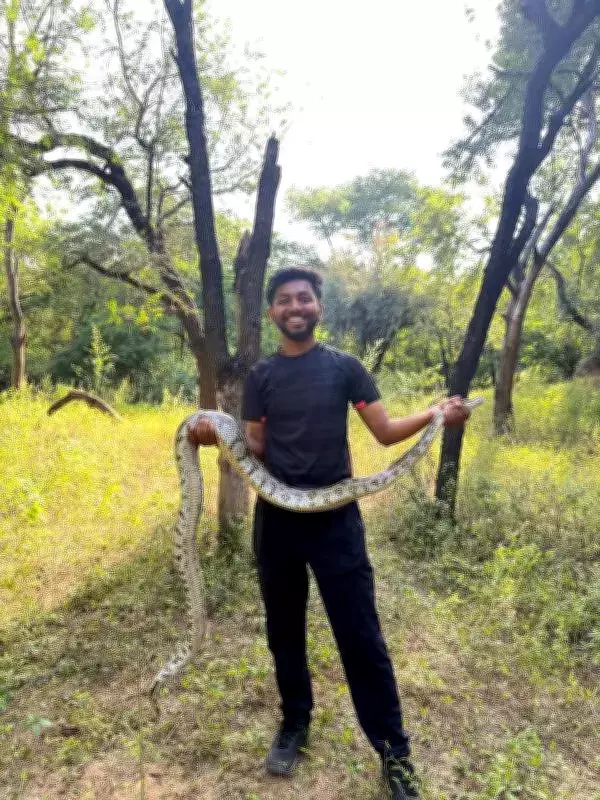
It begins with a simple WhatsApp message containing a location pin. Before most people even glance up from their phones, young volunteers are already en route to a construction pit, a mobile tower, or a burrow in the ground. Across Gujarat, students, mechanics, accountants, and teenagers—some as young as 12 years old—are building informal yet highly serious rescue networks dedicated to saving wildlife.
Armed with Compassion and Tools
These volunteers operate quietly but effectively, equipped with hooks, torches, and cameras. They step into tense, unpredictable situations where every second counts to rescue birds, snakes, and various wild animals. What unites them is a shared refusal to let fear determine an animal's fate, fighting against panic and cruelty one rescue at a time.
Jay Parekh, a 21-year-old resident of Gandhinagar, experienced this harsh reality firsthand. A call came from Chiloda about a snake that had retreated into a burrow. Parekh, who began rescues in Class 11, waited patiently for hours. When the tail finally appeared, he moved swiftly, but it was too late. The spectacled cobra was already dead. A local woman later confessed that someone, in a panic, had poured acid into the burrow before help could arrive. "We try to save life, and then we see what fear and cruelty can do," Parekh reflects somberly.

Transforming Perspectives Through Action
In Kutch, 22-year-old Raj Garva faces similar battles almost daily. A car mechanic from Mirzapur who grew up in Devisar watching villagers kill snakes on sight, Garva's perspective changed when neighbor Jagdish Parmar explained the ecological importance of snakes. Over four years, Garva has rescued nearly 2,000 snakes. He and fellow volunteers travel up to 85 kilometers—sometimes as far as Bhachau or Mundra—at their own expense to respond to emergency calls.
"People often ask if a snake can be killed," Garva says. "We tell them to simply watch it and refrain from picking it up, even with a stick." This educational approach is crucial in changing community attitudes toward wildlife.
Urban Lifelines for Wildlife
In Ahmedabad, five friends have established an informal WhatsApp group that collaborates with NGOs and the forest department. Sahil Lagad, a 19-year-old BCA student, joined at age 15 after helping rescue a dog in Sanand. He now operates strictly by protocol, emphasizing that "injured peacocks must go to the forest department immediately" as he recites wildlife laws from memory.
One particularly challenging rescue involved a crow entangled in manja (kite string) near the top of a mobile tower at Shantivan. "Police blocked the road. Two fire brigade vehicles raised hydraulic ladders, and we successfully rescued the bird," explains Lagad, who led the mission.
Working alongside him is Saloni Zaveri, a 23-year-old accountant known for her fearless fieldwork. She recently assisted a 10-member team in lifting an injured nilgai from a construction pit while keeping stray dogs at bay. The group also includes Het Shah (21), Meet Shah (20), and Tirthraj Upadhyay (20).
Their most grueling mission involved a macaque with severe facial injuries, missing an eye and part of its jaw—likely due to human cruelty. "We tracked the animal for five months, sitting for up to seven hours daily to earn its trust," says Tirthraj. Tragically, the monkey died from stress two days after capture. Despite such setbacks, the group has rescued approximately 250 animals and birds so far, according to Het.
Rescue Through the Lens
Some volunteers contribute not with hooks but with cameras. Jaimin Bhavsar, a 20-year-old from Gandhinagar, always dreamed of becoming a photographer. Severe migraines derailed his plans to study abroad but not his determination. He began using an SLR camera in Class 5 and took video-editing jobs in Class 10 to save for professional equipment. Today, he has documented 12 owl species across Gujarat. "Owls taught me the value of the night," he shares.
Kavya Panchal, 14, uses her camera to deepen her understanding of nature. Aryan Modi, 15, has already built a 2TB wildlife archive, having started birding at age two under his grandfather's guidance.

The youngest member is 12-year-old Rian. His first photograph—a bird perched on a tree in Gir—was so well-composed that his father, J N Patel, immediately handed him his professional DSLR. Rian spent the rest of that trip tracking lions and now photographs tigers in Ranthambore with patience that defies his age.
Essential Equipment and Safety Protocols
Most snake rescues involve the 'Big Four': spectacled cobra, Russell's viper, common krait, and saw-scaled viper. Standard equipment includes snake hooks, ventilated transport boxes, and high-intensity torches. The golden rule: never handle snakes alone, and always know the location of the nearest anti-venom center.
How You Can Help
If you encounter an injured animal or bird, observe from a safe distance. Contact trained rescuers or the forest department immediately. Do not attempt to handle protected wildlife. For small birds, use a ventilated box and avoid force-feeding water. One simple preventive measure is to keep a water bowl outside, which can help avert emergencies by providing hydration to wildlife.





