

Gujarat Sets Ambitious 2035 Targets for Greening and Forest Expansion
In a significant move towards environmental conservation, the Gujarat Forest and Environment Department has outlined a comprehensive greening strategy with ambitious targets set for the year 2035. The plan, presented at a recent Committee of Secretaries (COS) meeting in Gandhinagar, focuses on substantially increasing the state's green cover while addressing critical issues like human-wildlife conflict through innovative technological solutions.
Detailed Greening Targets for 2035
The department's presentation revealed specific numerical goals for various environmental parameters. Currently, Gujarat's forest cover stands at 15,017 square kilometers, representing 7.65% of the state's total geographical area. The department aims to expand this to 17,100 square kilometers by 2035, marking a substantial 9% increase that would add 2,083 square kilometers of forested land.
Similarly, the state's tree cover, presently at 6,632 square kilometers (3.38% of geographical area), is targeted to reach 7,850 square kilometers by 2035, representing a 4% increase. When combined, the overall green cover - encompassing both forest and tree cover - currently measures 21,649 square kilometers. The department proposes expanding this to 24,950 square kilometers, achieving a 12.71% increase through the addition of 3,301 square kilometers.

Special Focus on Mangroves and Grasslands
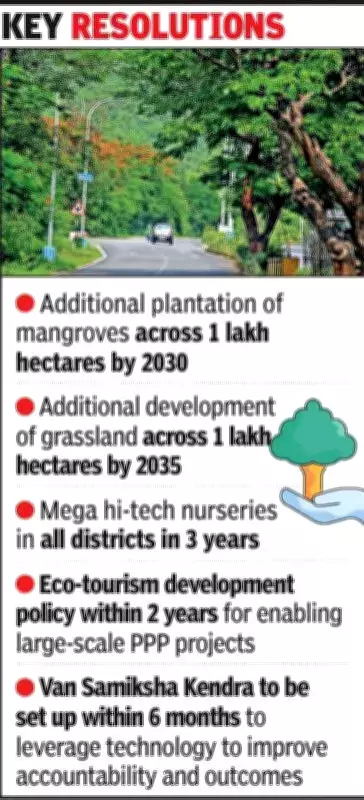
The plan includes specific attention to coastal ecosystems and grasslands. Mangrove plantation areas are slated to expand by 336 square kilometers, growing from the current 1,164 square kilometers to 1,500 square kilometers by 2035. This represents a significant commitment to coastal biodiversity and protection against erosion.
In the Kutch district, the Banni grassland - an important ecological zone - will see expansion from 170 square kilometers to 570 square kilometers, adding 400 square kilometers to this crucial habitat. These targeted expansions demonstrate a nuanced approach to different ecosystem types within the state.
Addressing Human-Wildlife Conflict with Technology
The presentation highlighted a serious concern regarding human-wildlife interactions, revealing that between 2019-20 and 2025-26, there have been 198 human deaths and 1,023 injuries resulting from wildlife conflicts. Leopards were identified as responsible for 54% of deaths (106 fatalities) and 64% of injuries (657 cases).
To address this challenge, the department proposed implementing artificial intelligence solutions as part of a comprehensive strategy to reduce wildlife-human conflicts. This technological approach represents an innovative method for managing the interface between human settlements and wildlife habitats.
Strategic Context and Implementation Focus
Despite Gujarat ranking second in forest cover increase according to the India State of Forest Report (ISFR) 2023, the state still remains below the national average. The department emphasized that the coming decade requires precision in implementation, moving beyond mere planting targets to focus on survival rates, density improvement, and community stewardship of green initiatives.
The comprehensive plan represents a multi-faceted approach to environmental management, combining quantitative expansion targets with qualitative improvements and technological interventions to create a more sustainable ecological future for Gujarat.






