Gurgaon's Alarming Tree Loss: Over 12,500 Trees Felled in One Year
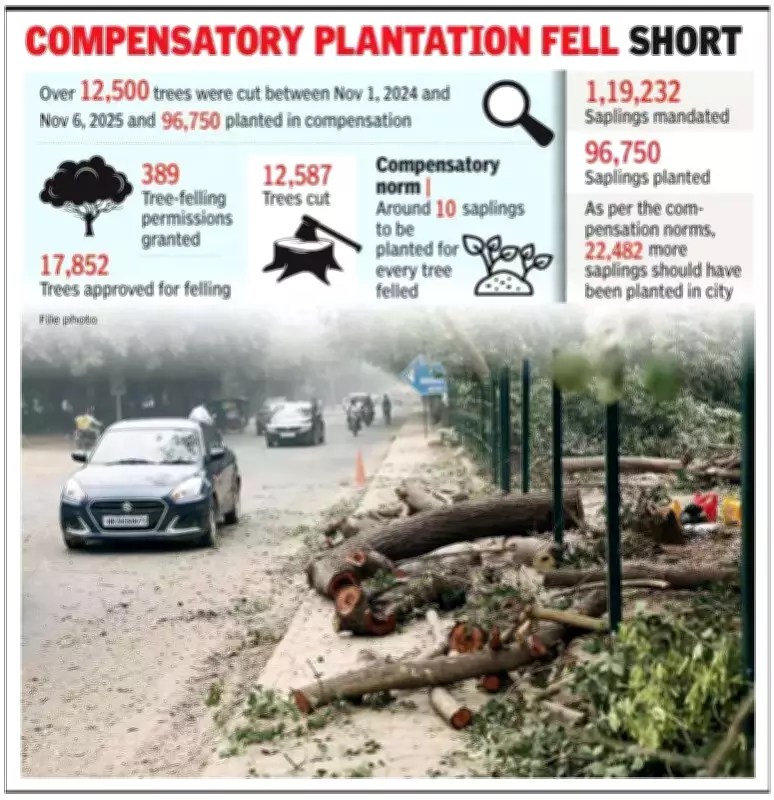
A shocking compliance report submitted before the National Green Tribunal (NGT) has revealed that more than 12,500 trees were felled across Gurgaon over a one-year period. The data, covering November 1, 2024 to November 6, 2025, exposes significant gaps in environmental compliance and compensatory plantation efforts in the rapidly developing city.
Official Data Shows Massive Tree Removal with Inadequate Compensation
According to the joint committee report, authorities granted 389 permissions for felling 17,852 trees during the specified period. Of these approved removals, 12,587 trees were actually cut down, representing substantial urban deforestation. Under compensatory plantation norms, agencies were required to plant 1,19,232 saplings to offset the ecological damage caused by tree removal.
However, Haryana forest department data shows only 96,750 saplings were actually planted, leaving a concerning shortfall of 22,482 plants. This represents approximately one in every five saplings that were mandated for planting, highlighting systemic failures in environmental compensation mechanisms.

"In effect, while authorities were required to plant about 95 saplings for every 10 trees cut, they managed only around 77," the figures clearly demonstrate. This significant gap raises serious questions about the effectiveness of current environmental protection measures in urban development zones.
NGT Hearing Reveals Regulatory Failures and Environmental Concerns
The compliance report was filed following NGT directions issued on November 11, 2025, when the tribunal asked the Haryana government to submit a detailed affidavit covering:
- Tree-felling permissions granted over the past year
- Actual number of trees cut
- Compensatory plantation efforts
- Sapling survival rates
The forest department was given eight weeks to file this comprehensive report. The tribunal was hearing a plea filed by environmentalist Vaishali Rana on November 6, who alleged that approvals were being granted "mechanically" without proper oversight.
"Haryana failed to verify on-ground compliance with felling conditions and neglected follow-up monitoring of compensatory plantations," Rana stated in her petition. Her counsel sought a temporary ban on tree cutting in Gurgaon until a proper regulatory mechanism is established, though the tribunal allowed the petitioner to file a separate plea seeking interim relief on this matter.
Broader Pattern of Tree Removal Across Development Projects
This data emerges against a backdrop of repeated clearances of mature trees in Gurgaon for various infrastructure projects:
- Approximately 5,000 trees were felled in 2017 for flyovers and underpasses along NH8
- Permission was granted to cut nearly 10,000 trees in 2018 for widening of Sohna Road
- Recently, 344 trees were approved for removal between sectors 27 and 43
- Additional trees were cleared along highway stretches in Gurgaon and Rewari forest divisions
An RTI response further revealed that while authorities approved felling of over 500 trees across various projects, only 124 were transplanted, and compensatory plantation for nearly 3,800 trees remained pending, indicating a pattern of inadequate environmental mitigation.
Judicial Scrutiny and Regulatory Framework Under Review
The NGT bench, led by Justice Prakash Shrivastava and Afroz Ahmad, questioned how permissions are issued and monitored. Appearing for the state, counsel Rahul Khurana noted that the wider regulatory framework for tree-felling permissions is already under scrutiny in another matter, where the Central Pollution Control Board (CPCB) has submitted recommendations.
That case is listed for January 27, 2026, the same date the present matter will also be heard, suggesting coordinated judicial oversight of environmental regulations in Haryana.

In a related development, the Punjab and Haryana High Court recently restrained the Haryana government from cutting more trees on a 38-acre green patch in Rohtak's proposed Sector 6, asking pointedly, "Why are you cutting these trees within Rohtak itself? You don't want your children or your grandchildren to survive?"
Forest Department Response and Future Monitoring
Forest officials acknowledged that pending plantations reflected in the compliance report must be completed by the concerned agencies. They added that monitoring systems are being reviewed to improve adherence to timelines and ensure better environmental compliance.
The state government stated that compensatory afforestation is being carried out near the Kundli–Manesar–Palwal Expressway for metro projects, where approximately 30,000 trees are being planted to compensate for the felling of about 3,000 trees, representing a positive ratio but limited to specific projects.
This comprehensive report highlights the urgent need for stronger enforcement of environmental regulations, better monitoring of compensatory plantations, and more transparent approval processes for tree felling in rapidly urbanizing areas like Gurgaon.