

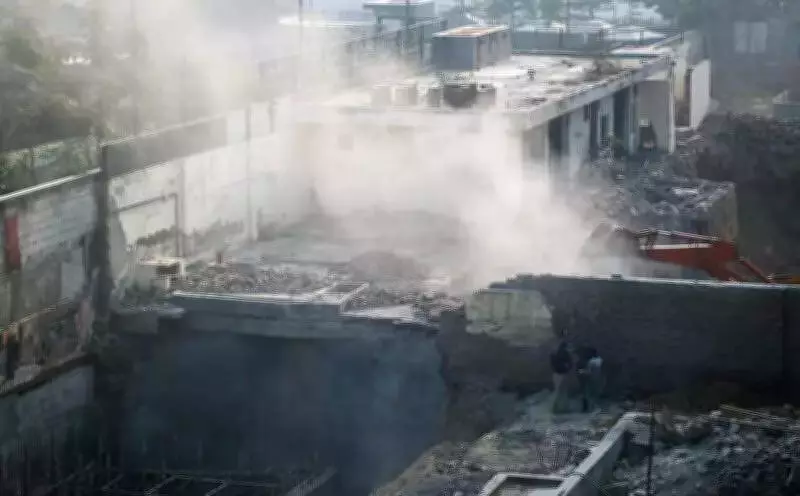
Gurgaon's Construction Dust Problem: Widespread Non-Compliance with Air Monitoring Rules
In Gurgaon, construction dust continues to be a significant contributor to air pollution, yet alarmingly, only around 15% of large construction projects in the city are adhering to mandatory air quality monitoring regulations. Data from Haryana's dedicated dust-control web portal reveals that merely 461 construction projects measuring 500 square metres or more have registered so far, despite an estimated 3,000 such sites operating across the city.
Massive Compliance Gap in Pollution Monitoring
This stark discrepancy indicates that approximately 85% of large construction projects are functioning outside the official monitoring framework designed to track and control dust emissions. Registration on the portal is compulsory under directives issued by the Commission for Air Quality Management (CAQM), which also mandate the installation of PM2.5 and PM10 sensors connected to a live dashboard for real-time pollution tracking.
The system aims to enable regulators to remotely oversee dust mitigation measures at construction sites throughout the National Capital Region (NCR). However, the low registration numbers highlight a persistent compliance issue, even as Gurgaon grapples with consistently poor air quality and recurrent pollution spikes linked to construction activities.

Enforcement Actions and Official Warnings
Officials have stated that enforcement against non-compliant projects has been intensified. "We have issued notices to all large units and will not permit them to operate if they fail to adhere to the norms. Inspections are being carried out at construction sites that have not yet registered on the portal," said Akansha Tanwar, regional officer of the Haryana State Pollution Control Board (HSPCB).
Tanwar urged project proponents to complete their registration promptly, warning of severe consequences for non-compliance. "We will halt construction activities at these projects, impose penalties, and prosecute them in the environmental court. They are responsible for adding pollution to the environment," she emphasized.
Regulatory Framework and Implementation Challenges
Haryana launched the dust-control portal in January 2024 to facilitate real-time monitoring of pollution levels at construction sites. The platform features a live dashboard that displays ambient air quality data from individual projects, implemented in accordance with CAQM directions issued on October 1, 2021.
These directives make registration obligatory for all construction projects on plots of 500 square metres or larger, along with the installation of PM2.5 and PM10 sensors linked to the portal. Additionally, project proponents must implement video fencing with remote connectivity to enable continuous surveillance of dust-control measures.
Despite this regulatory framework being in place for over three years, the low registration figures point to a significant enforcement gap. When questioned about steps to ensure compliance, the HSPCB official mentioned that the board has requested civic agencies to share building plan data. This would allow authorities to "cross-reference with environmental clearance documents and identify non-registered sites."
Dust Mitigation Measures and Monitoring Protocols
Civic bodies have also received a checklist to monitor compliance with dust mitigation measures in the NCR, to be implemented through the online mechanism. The prescribed dust control and mitigation strategies include:
- Use of anti-smog guns
- Deployment of water pills
- Operation of water cannons
- Utilization of hoses and fire hydrants
- Installation of sprinklers
These measures are critical for reducing particulate matter emissions from construction sites, which significantly impact air quality in urban areas like Gurgaon. The ongoing non-compliance underscores the challenges in enforcing environmental regulations, even as the city faces mounting pressure to address its air pollution crisis.






