

Gurgaon Air Quality Network Undergoes Major Recalibration to Address Data Overlaps
In a significant move to enhance the accuracy of pollution tracking, Gurgaon's air quality monitoring network is being recalibrated to correct overlapping readings from the Aravali belt. The air monitoring station at Teri Gram will be relocated to Bhondsi, shifting from a zone that replicates data from nearby Gwalpahari to a peri-urban area with mixed residential and semi-rural activities.
Current Network and Expansion Plans
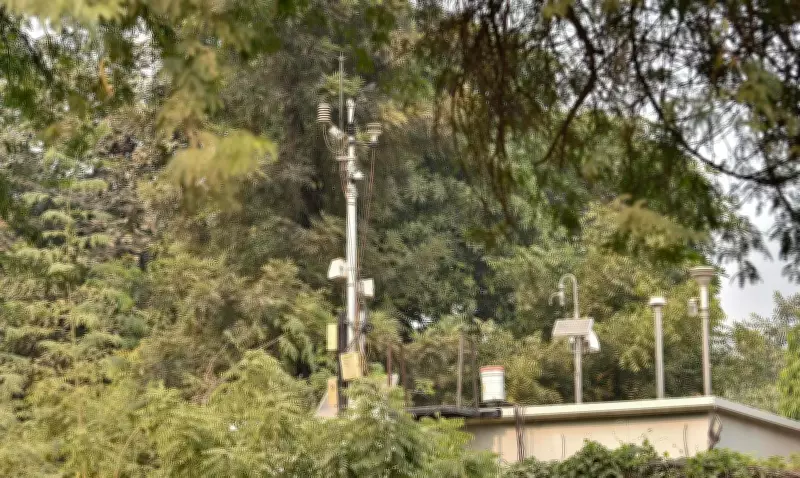
At present, Gurgaon operates five air monitoring stations located at Vikas Sadan, Teri Gram, Gwalpahari, Sector 51, and Manesar. The Teri Gram and Gwalpahari stations, situated barely a kilometre apart along the Aravalis, often record similar pollution trends, leading to redundant data collection.
The relocation to Bhondsi is part of a broader expansion initiative. Under this plan, five new real-time monitoring stations will be installed by the end of July, increasing the city's total network to ten stations. Akanksha Tanwar, HSPCB regional officer in Gurgaon, stated, "Moving one of the stations to Bhondsi is expected to plug a key gap in how the city's air is currently measured, providing a more diverse representation of land-use zones."

Expert Concerns and Data Implications
However, environmental experts have raised cautions about the potential impact of this relocation on official air quality data. Manoj Kumar, an air analyst at CREA, explained, "The relocation of the station to Bhondsi may lead to an apparent reduction in the city's average pollution levels without reflecting a true improvement in urban air quality. This shift risks underrepresenting pollution exposure in core urban areas."
Kumar emphasized that for accurate assessment, urban green sites should be treated as background locations, while peripheral and urban-influenced stations should represent the city's average pollution levels. This concern is particularly relevant given Gurgaon's current monitoring grid, which covers approximately 732 square kilometres but leaves large parts, especially newer sectors and fringe areas, outside air quality assessment.
Past Challenges and Reliability Issues
The gaps in monitoring have been sharply highlighted in previous incidents. In October last year, three of the city's four stations—at Gwalpahari, Teri Gram, and Sector 51—went offline due to technical snags and delayed calibration. This left Vikas Sadan as the only functional station, skewing Gurgaon's Air Quality Index to a "moderate" level despite visible smog conditions.
This outage raised serious concerns over the reliability of air quality data during peak pollution periods. Additionally, a TOI report earlier flagged that several monitoring stations are surrounded by dense tree cover, and in some cases recorded incomplete pollutant data, leading to unusually low AQI averages. Experts pointed out that limited stations combined with problematic locations and missing data could distort Gurgaon's overall pollution profile.
New Station Locations and Scientific Recommendations
Under the new expansion plan, HSPCB will set up stations at Tau Devi Lal Park, Leisure Valley Park, WTP Chandu, STP Jahajgarh, and STP Dhanwapur. These sites have been selected to represent a mix of residential, green, and utility-linked zones, aiming for a more balanced data collection.
TOI reported earlier that a CAQM panel called for a denser and more scientifically distributed monitoring network across the National Capital Region. The panel recommended a grid-based model of one station per 25 square kilometres in major cities. Even with the planned additions, Gurgaon's network will fall short of this benchmark. By the grid-based model, a city of Gurgaon's size would require around 29 stations, nearly three times the proposed count.
The gap becomes clearer when compared with Delhi, which operates around 40 stations across 1,483 square kilometres, enabling far more granular tracking of pollution patterns.

Future Steps and Expert Insights
Sunil Dahiya, founder and lead analyst at think-tank Envirocatalysts, commented, "Expanding the monitoring network to ten stations is a step toward making Gurgaon's air quality data more scientifically robust. Relocating stations to avoid duplication and intentionally placing new ones in residential zones, rather than just 'green islands', is crucial. For data to be actionable, it must reflect the actual exposure levels of the citizens where they live and work, not just where the air is cleanest."
Dahiya added that measuring air quality is the first step towards taking directed actions to improve it, anticipating stricter measures on cutting down emission sources once these stations are operational.
Guidelines by the Central Pollution Control Board also indicate that cities with populations between 10 lakh and 50 lakh should have multiple continuous and manual monitoring stations to ensure representative data. Gurgaon, with a population exceeding 15 lakh, has repeatedly been flagged for limited spatial coverage.
Conclusion: A Course Correction, Not a Complete Fix
Officials stated that the twin steps of relocating a redundant station and adding new ones will make the network more representative. However, experts view the current plan as a course correction rather than a complete fix, with gaps in high-exposure areas likely to persist. The recalibration and expansion aim to provide a clearer picture of Gurgaon's air quality, but ongoing efforts will be necessary to achieve comprehensive and accurate pollution monitoring.





