Gurgaon's Air Quality Takes a Sharp Dive into 'Very Poor' Territory
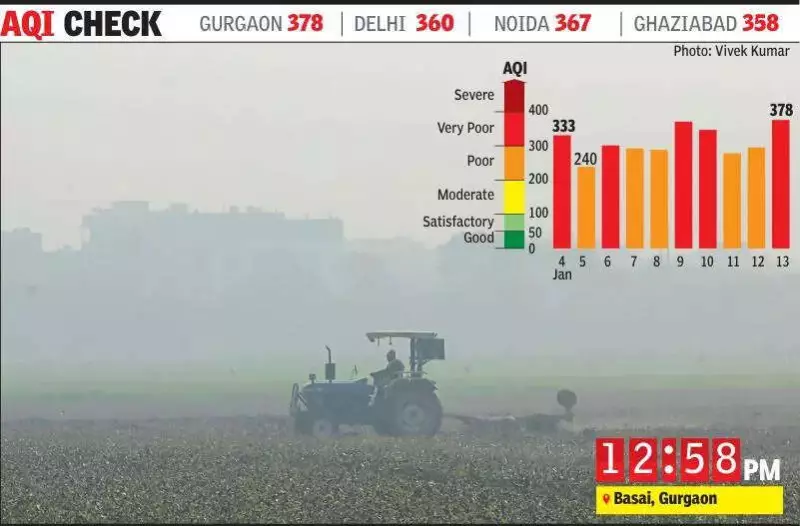
Gurgaon residents woke up to dangerously polluted air on Tuesday. The city's air quality index plummeted from 297 on Monday to 378 in just 24 hours. This dramatic shift pushed Gurgaon from the 'poor' category straight into the 'very poor' zone.
Monitoring Stations Paint a Grim Picture
Three out of four active air monitoring stations reported alarming readings above 300. Two stations actually crossed into the 'severe' range. Sector 51 recorded a worrying AQI of 436 while Vikas Sadan followed closely at 434.
Gwalphari maintained its position in the 'very poor' category with a reading of 326. Only Teri Gram remained in the 'poor' range at 288. These numbers reveal widespread pollution across different parts of the city.

A Persistent Pollution Problem
This isn't an isolated incident. Gurgaon has experienced repeated pollution spikes since the beginning of the month. Readings have crossed the 300 mark on multiple days already.
The sharpest rise occurred on January 9th when the AQI hit 373. January 10th followed with 349, and January 4th recorded 333. These numbers indicate that pollution levels have remained persistently high despite some temporary improvements.
The recent trend shows particularly concerning fluctuations. After reaching 349 on January 10th, air quality improved to 280 on January 11th. It then rose again to 297 on January 12th before spiking dramatically to 371 on Tuesday. This pattern suggests a worsening situation rather than temporary blips.
Health Experts Sound the Alarm
Health advisories warn that prolonged exposure to very poor air quality poses serious risks. Respiratory illnesses can develop or worsen, especially among vulnerable groups.
Children, elderly citizens, and people with pre-existing heart or lung conditions face the greatest danger. The state dashboard clearly notes that air at these levels can cause serious respiratory problems with extended exposure.
An AQI between 301 and 400 falls into the 'very poor' classification. This range is associated with increased respiratory stress for everyone, but particularly affects sensitive populations.
Why Winter Brings the Worst Pollution
Experts point to specific atmospheric conditions that worsen winter pollution. Stagnant air patterns create perfect conditions for pollutants to accumulate near the surface.
Low wind speeds and reduced mixing height prevent pollutants from dispersing. Vehicle emissions, construction dust, and other local sources get trapped close to ground level. Without proper dispersal conditions, these pollutants quickly push air quality into hazardous ranges.
Officials explain that calm winds combined with winter inversion layers trap pollutants effectively. They warn that significant improvement seems unlikely without weather changes. Stronger winds or rainfall would help disperse the accumulated pollution.
Practical Advice for Residents
Authorities have issued clear guidelines for Gurgaon residents. People should avoid prolonged outdoor exposure, particularly during peak pollution hours. Outdoor exercise should be limited until air quality shows measurable improvement.
The situation extends beyond Gurgaon too. Delhi's air quality has also deteriorated to the 'very poor' zone with an AQI of 360. This marks a decline from Monday's reading of 297 in the 'poor' range.
According to the Centre's Air Quality Early Warning System for Delhi, the air quality index will likely remain in the 'very poor' category until at least January 16th. The forecast suggests conditions may persist even beyond that date.