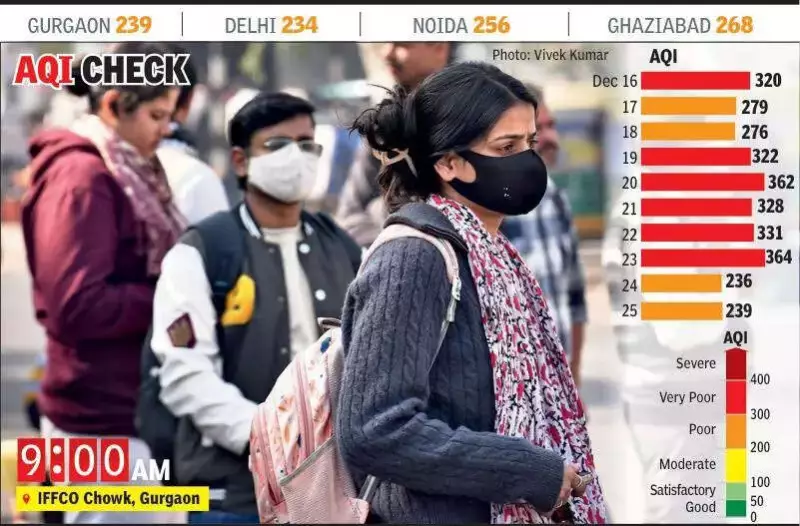
For the second consecutive day, the air quality in Gurgaon remained firmly in the 'poor' category on Thursday. Data from the Central Pollution Control Board (CPCB) showed the city's overall Air Quality Index (AQI) climbed slightly to 239, up from 236 recorded the previous day.
Uneven Pollution Across Monitoring Stations
Readings from the city's active monitoring stations painted a picture of uneven pollution distribution. Sector 51 recorded the worst air in the city with an AQI of 310, placing it in the 'very poor' category. Teri Gram followed with a 'poor' AQI of 214, while NISE Gwalpahari registered a comparatively better, yet concerning, reading of 194 (moderate-to-poor).
The concentration of dangerous particulate matter told a similar story. The level of PM2.5 – fine particles that can enter the bloodstream via the lungs – was highest in Sector 51 at 298 micrograms per cubic metre (µg/m³). Teri Gram recorded 274 µg/m³ and Gwal Pahari 245 µg/m³. PM10 levels also peaked in Sector 51 at 285 µg/m³.

Health Risks and Exceeded Safety Limits
These readings far exceed the national safety standards. The CPCB mandates annual average limits of 40 µg/m³ for PM2.5 and 60 µg/m³ for PM10. The 24-hour safe standards are 60 µg/m³ and 100 µg/m³ respectively. Prolonged exposure to the current pollution levels can cause breathing discomfort, particularly affecting children, the elderly, and individuals with existing respiratory conditions.
Officials pointed to meteorological conditions like low wind speed and temperature inversion as key factors trapping pollutants close to the ground. A slight improvement in dispersion conditions earlier in the week had provided minor relief, pulling the AQI out of the 'very poor' zone temporarily.
Forecast: Worsening Conditions Ahead
The winter pattern of cold, still air allowing pollutants to hang suspended over Delhi-NCR is set to continue. Forecasts predict a deterioration in air quality. Wind speeds, currently between 4-6 kmph, are expected to decrease over the next three days. This is likely to push the AQI back into the 'poor' to 'very poor' range, according to forecasts.
The India Meteorological Department (IMD) predicts temperatures will remain in the current range, with shallow fog likely during late night and early morning hours.
In contrast, Delhi experienced clearer skies and improved visibility on Thursday, thanks to strong north-westerly winds dispersing pollutants for a second day. These chilly winds also brought down the minimum temperature to 6.5 degrees Celsius, a notch below normal and significantly lower than Wednesday's 10.2 degrees C. IMD scientist Krishna Kumar indicated a further dip of one or two degrees in the coming days.