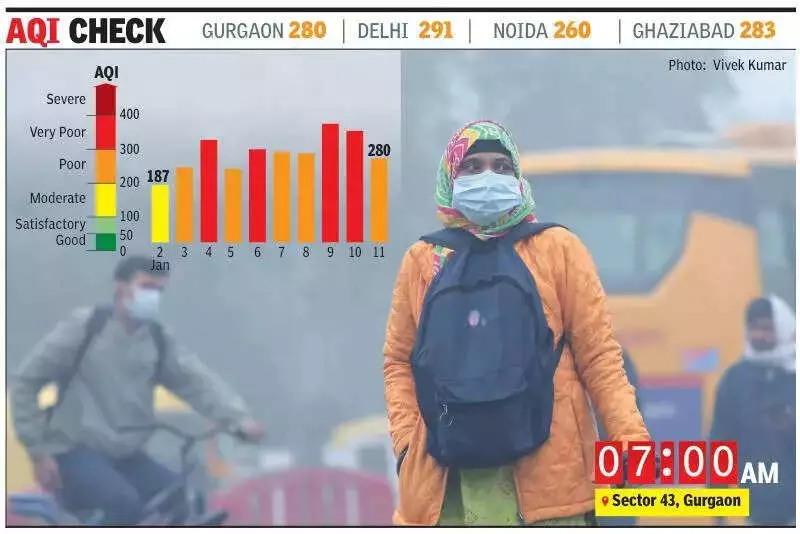
Residents of Gurgaon witnessed a marginal improvement in the city's air quality on Sunday, though it remained firmly in the 'poor' category. The overall Air Quality Index (AQI) settled at 280, a notable drop from the previous day's reading of 349. Officials attributed this slight relief to an increase in wind speed, which helped disperse some of the harmful pollutants hanging in the atmosphere.
Monitoring Stations Paint a Mixed Picture
Despite the overall improvement, the situation varied significantly across different parts of the city. Data from key monitoring stations revealed a concerning disparity. The Sector 51 station recorded the highest AQI of 304, which falls into the 'very poor' category as per the Central Pollution Control Board (CPCB) standards. Other areas continued to report 'poor' air quality, with Gwalpahari at 260, Teri Gram at 266, and Vikas Sadan at 299.
The concentration of deadly PM2.5 particles followed a similar pattern. Sector 51 again topped the list with a reading of 304 µg/m³. This was followed by Gwal Pahari (256 µg/m³), Teri Gram (245 µg/m³), and Vikas Sadan (239 µg/m³). For the larger PM10 particles, Teri Gram reported the highest level at 330 µg/m³, with Gwal Pahari at 321 µg/m³ and Sector 51 at 243 µg/m³. It is important to note that these figures are alarmingly high, as the CPCB's safe 24-hour average limits are set at just 60 µg/m³ for PM2.5 and 100 µg/m³ for PM10.

Winter Inversion and Unfavourable Forecast
Environmental officials stated that the current rise in pollution is consistent with typical winter conditions across North India. Low temperatures, calm winds, and morning fog create a phenomenon known as temperature inversion. This acts like a lid, trapping pollutants emitted from vehicles, construction sites, industries, and waste burning close to the ground, preventing their dispersion.
Weather forecasts suggest that residents should not expect sustained relief. According to the latest Decision Support Systems (DSS) bulletin, surface winds are expected to remain weak, with speeds below 10 km/h on the morning of January 12. While speeds may increase slightly in the afternoon, they are predicted to drop again by evening. The forecast also indicates partly cloudy skies with shallow to moderate fog during morning hours.
Dispersion Conditions Expected to Worsen
Projections from the DSS paint a grim picture for the immediate future. The bulletin estimates that the mixing depth—the vertical height available for pollutants to disperse—will dip to a low of 800 meters on January 12. Although it may improve to 1,000 meters on January 13, the ventilation index is projected to stay below 6,000 m²/s. A critical threshold noted by the DSS is when this index falls below 6,000 m²/s while average wind speed remains under 10 km/h, creating conditions highly unfavourable for pollutant dispersion.
Health experts have reiterated advisories, cautioning that prolonged exposure to air of such poor quality can lead to significant breathing discomfort. The risks are particularly high for vulnerable groups, including children, the elderly, and individuals with pre-existing respiratory or cardiovascular conditions. Authorities urge citizens to limit outdoor activities during peak pollution hours and to use protective masks when necessary.