Gurgaon's Dust Crisis: Severe Shortage of Road Sweepers Worsens Air Pollution
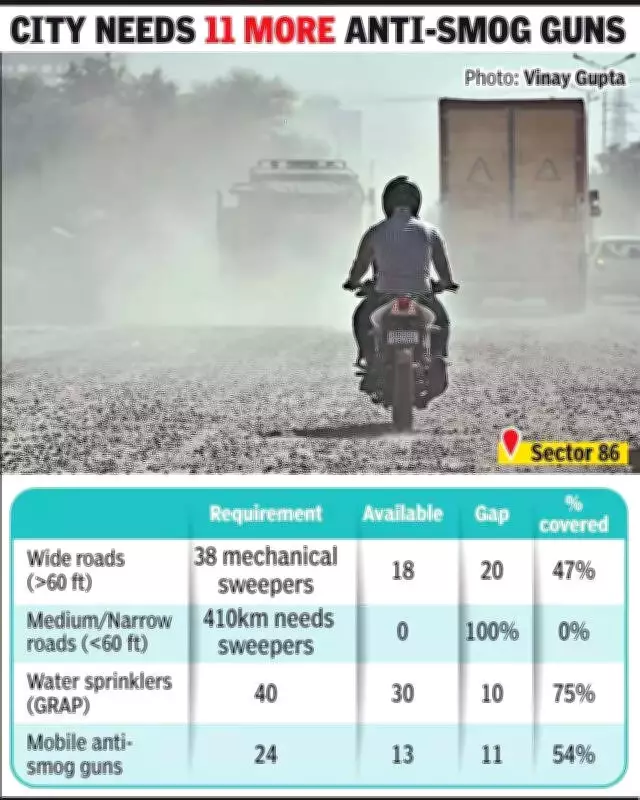
The city of Gurgaon continues to grapple with escalating road dust pollution, primarily due to a severe shortage of mechanical road sweeping machines. Despite having 287 kilometers of roads wider than 60 feet, which require 38 large mechanical road sweepers, only 18 are currently operational. This leaves a glaring deficit of 20 machines, according to official data.
Persistent Deficit Despite Regulatory Directives
This critical gap persists despite repeated directives from the Commission for Air Quality Management, which has mandated strict technical and operational standards for mechanized sweeping across the National Capital Region. Bridging this shortfall is estimated to cost approximately Rs 26 crore, but procurement remains stalled, awaiting administrative approval.
Mechanical road sweeping machines are specialized vehicles designed to sweep and vacuum fine dust while simultaneously spraying water to suppress airborne particles. The collected dust is stored in hoppers and filtered to prevent its re-release into the atmosphere. The CAQM has further mandated that new fleets must operate on CNG or electric power to minimize additional pollution.

Acute Impact on Gurgaon's Air Quality
The issue is particularly severe in Gurgaon, where road dust constitutes a major contributor to particulate pollution. This problem is exacerbated by heavy traffic, ongoing construction activities, and unpaved road shoulders. During dry months, the CAQM has warned that road dust significantly spikes PM10 levels and contributes to PM2.5 pollution through re-suspension.
Auxiliary dust-control measures are also inadequate. Gurgaon requires 40 water sprinklers during Grap periods but has only 30 available. Similarly, just 13 mobile anti-smog guns are operational against a requirement of 24, with funding for additional units still pending.
Expanding Scope of the Problem
The challenge extends beyond wide roads. Gurgaon also has 99.64 kilometers of medium-width roads and 311.16 kilometers of narrow roads. However, no medium or small mechanical road sweepers have been deployed or even proposed for these areas. This leaves over 410 kilometers of the city's road network outside the mechanized sweeping framework, directly violating CAQM norms that require separate machines for different road widths.
CAQM's Comprehensive Guidelines
In its latest directive dated February 10, the CAQM established uniform technical and operational norms for mechanized sweeping across the NCR. The commission identified road dust as a dominant contributor to PM10 and a significant source of PM2.5, especially during dry months. It directed that mechanical road sweepers must be deployed strictly according to road width, with separate specifications for large, medium, and small roads.
Machines must be equipped with integrated water spraying and particulate matter filtration systems to prevent dust re-suspension. The CAQM also mandated that mechanical road sweepers operate for at least eight hours per shift, follow declared sweeping schedules, run on CNG or electric fuel in new fleets, and ensure scientific disposal of collected dust to prevent its re-entry into the ambient air.
Expert Warnings: Beyond Mechanical Sweeping
Experts caution that while mechanized sweeping is useful, it cannot be viewed as a complete solution. Anumita Roychowdhury, executive director of research and advocacy at the Centre for Science and Environment, emphasized that focusing solely on mechanical road sweepers will not solve Gurgaon's dust problem.
Roychowdhury advocates for a comprehensive road redevelopment approach, where entire road networks are rebuilt with properly paved carriageways, footpaths, shoulders, avenue greening, and well-designed drains. These measures directly reduce dust generation at the source. "Otherwise, sweeping and water sprinkling become a never-ending exercise. You collect dust, dump it somewhere, and it re-enters the air. Even the fuel used to run these machines adds to pollution. Without fixing the roads themselves, sweepers alone cannot control dust," she explained.

Widespread Dust Across Key Areas
Previous reports have highlighted how loose dust remains pervasive across Gurgaon, from dug-up roads to exposed construction materials and garbage trucks. Particularly affected areas include:
- MG Road
- Udyog Vihar
- Sector 29
- Sushant Lok 1
- Galleria Market Road
- IFFCO Chowk
- Atlas Chowk
- Gurgaon-Faridabad Road
Health Hazards of Particulate Pollution
According to pollution authorities, the size of dust particles determines their health impact. Larger particles can cause skin and eye irritation, while inhalable fine particles penetrate deep into the respiratory tract, leading to conditions such as asthma, pneumonia, and allergic rhinitis. The ongoing shortage of mechanical road sweepers in Gurgaon thus represents not just an environmental concern, but a significant public health challenge that requires immediate attention and comprehensive solutions.