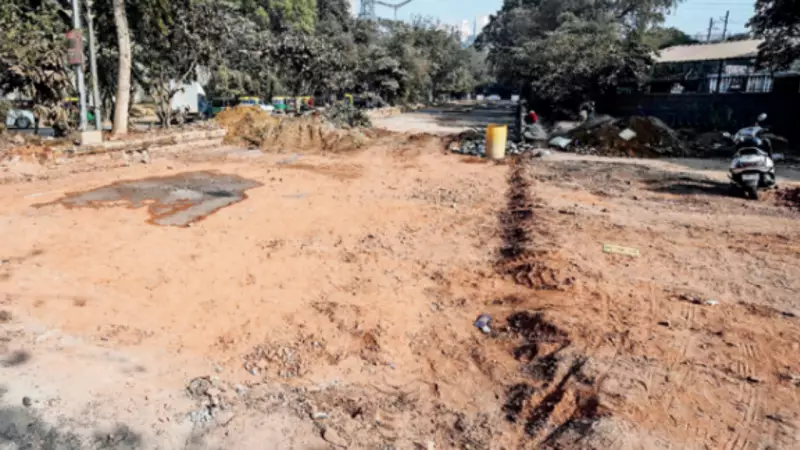
Despite a clear directive from Union Environment Minister Bhupinder Yadav to show "visible improvement" in air quality within a week, Gurgaon continues to be choked by thick clouds of loose dust from its dug-up roads and exposed construction sites. A ground inspection reveals that instructions to tackle road dust and poorly managed construction activity have largely been ignored across the Millennium City.
City Streets Turn Into Dust Bowls
A permanent haze of dust hangs over critical junctions and corridors, including Sector 29, Hero Honda Chowk, Dwarka Expressway, and Golf Course Road Extension. These areas, packed with ongoing construction projects and dilapidated roads, are major contributors to the city's pollution load. The situation is equally grim on MG Road, Udyog Vihar, Sushant Lok 1, Galleria Market Road, IFFCO Chowk, Atlas Chowk, and the Gurgaon-Faridabad Road.
On MG Road and near IFFCO Chowk, mounds of sand and cement are handled openly along pavements and medians. With no barricading or water sprinkling in place, every passing vehicle lifts fine dust into the air. This dust settles on shopfronts, parked vehicles, and even traffic police booths. "This stretch is always busy, but whenever road work starts, the dust becomes unbearable," said Rakesh Kumar, a commuter from Sohna Road. "Within minutes, you can feel it in your throat, especially during peak hours."

Residents and Commuters Bear the Brunt
At Atlas Chowk, large portions of the road have been scraped and left uneven for weeks. Gravel and exposed base layers spill into traffic lanes, creating dust clouds throughout the day. "Two-wheelers have it the worst here," said Ankit Verma, who works in Udyog Vihar Phase III. "There are no proper diversions or warning signs. By the time you reach the office, your clothes and helmet are covered in dust."
Interior roads in Sector 29 and Sushant Lok 1 have wide patches of bare earth and broken asphalt, effectively turning into open dust bowls without any fencing or covering. "It feels like we are living next to a construction site all the time," lamented Naina Gupta, a Sushant Lok 1 resident. "Even in the afternoon, windows have to stay shut because dust keeps blowing in."
The problem extends to high-footfall commercial areas like Galleria Market Road, where dug-up shoulders and debris lie close to pedestrian zones. On the Elan Mall road near Dwarka Expressway, fresh soil exposure along service lanes continues to add to the pollution.
Systemic Failure and Enforcement Gaps
The common thread across all these locations is the blatant absence of basic dust-control measures. Despite high winter pollution and tightening enforcement deadlines, there is:
- No regular water spraying
- No covered storage of construction materials
- A lack of proper barricading at sites
In a stark example at Civil Line, large mounds of excavated soil and fine construction material were dumped directly on the carriageway, narrowing the road and forcing vehicles to weave through loose, uncovered earth.
This inaction persists even as the Commission for Air Quality Management (CAQM) has reiterated directions to strictly enforce pollution control measures during the GRAP period. In a recent review, the commission noted that Haryana's performance in tackling road dust, traffic congestion at hotspots, and municipal waste disposal was inadequate.
The consequences are severe. Every winter, local emissions combine with adverse weather to blanket Delhi-NCR in smog. According to the Centre for Research on Energy and Clean Air, Gurgaon ranked as the fifth most polluted city among 238 Indian cities last winter, with an average PM2.5 concentration of 110 micrograms per cubic meter over the season—far exceeding safe limits.
As the city expands, the failure to implement basic dust mitigation measures on its broken roads and open construction sites continues to jeopardize the health of its residents and commuters, making the Union Minister's call for action ring hollow on Gurgaon's dusty ground.